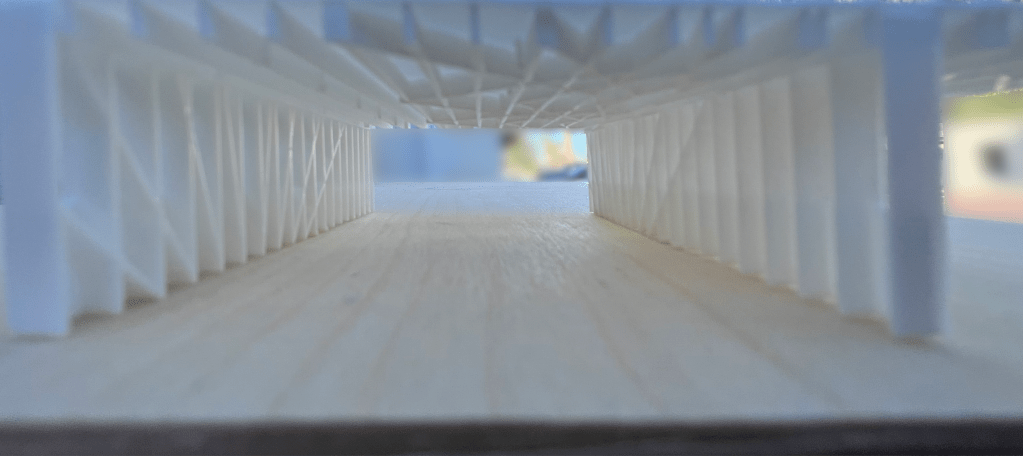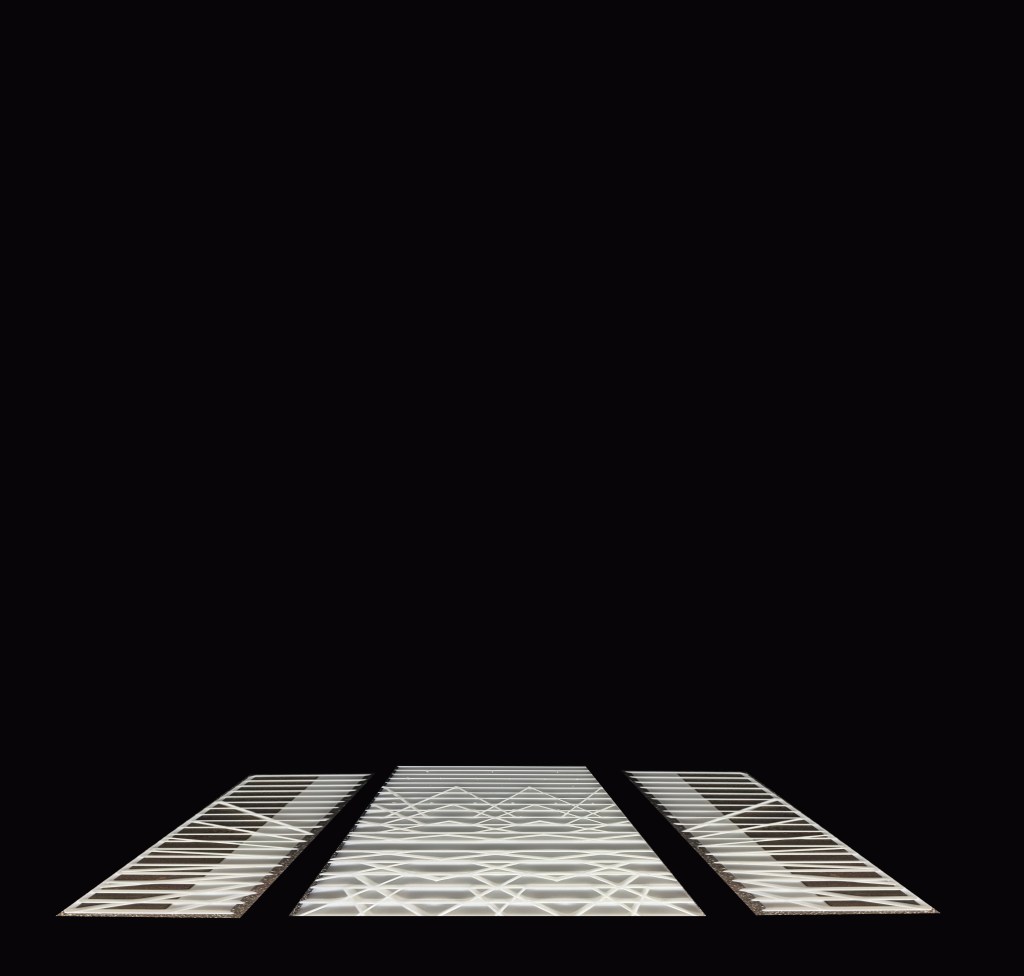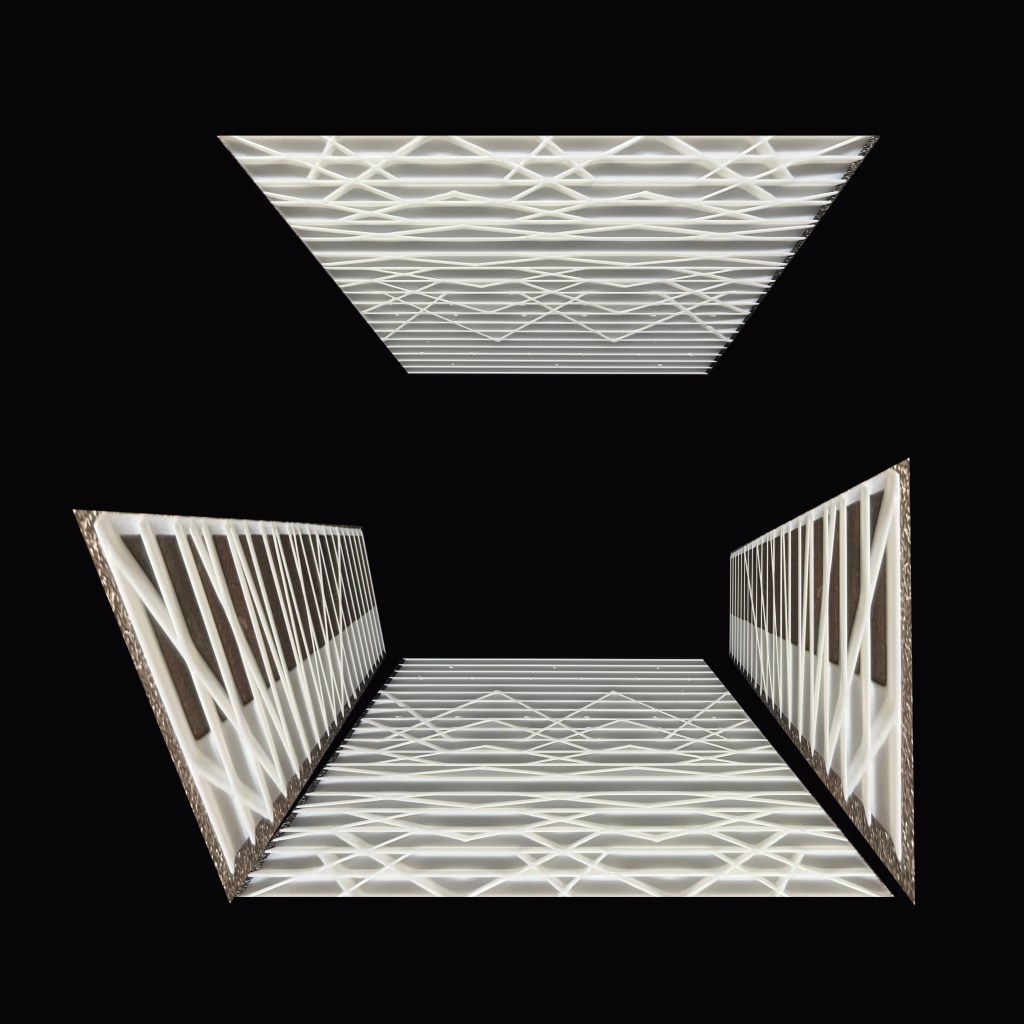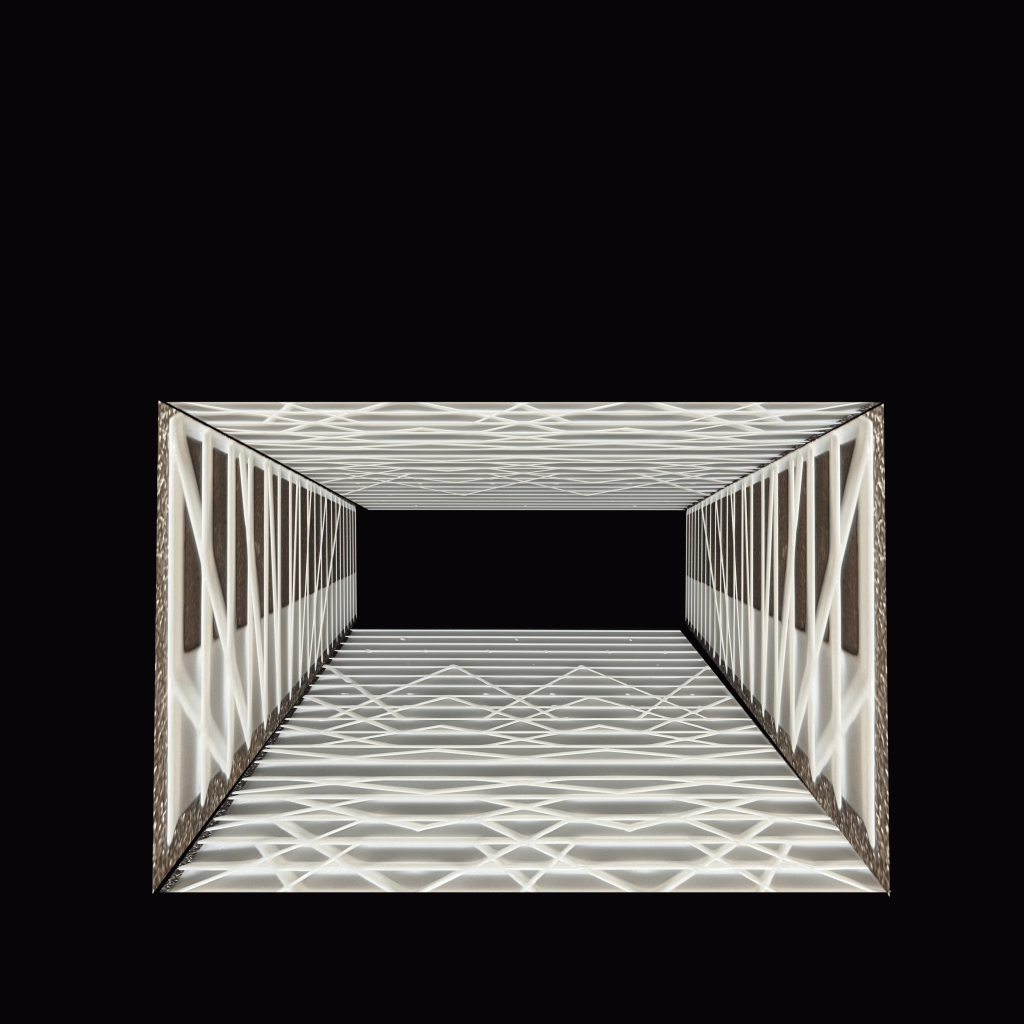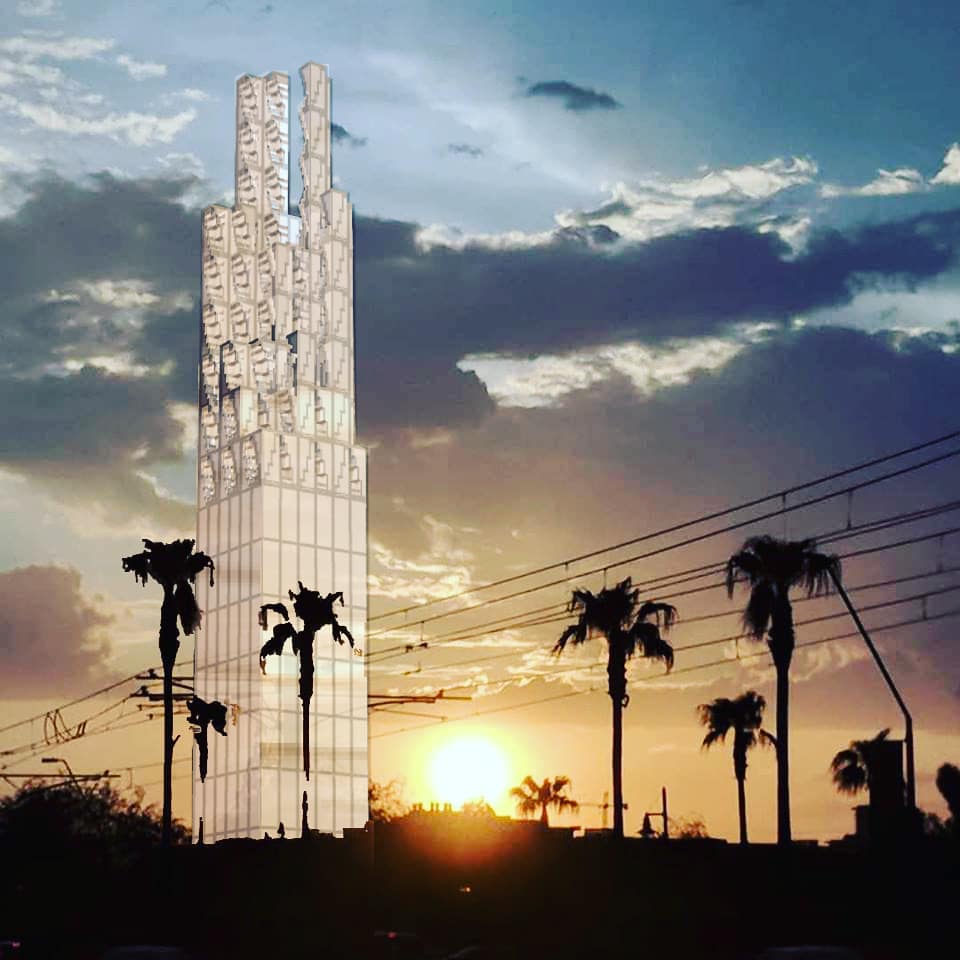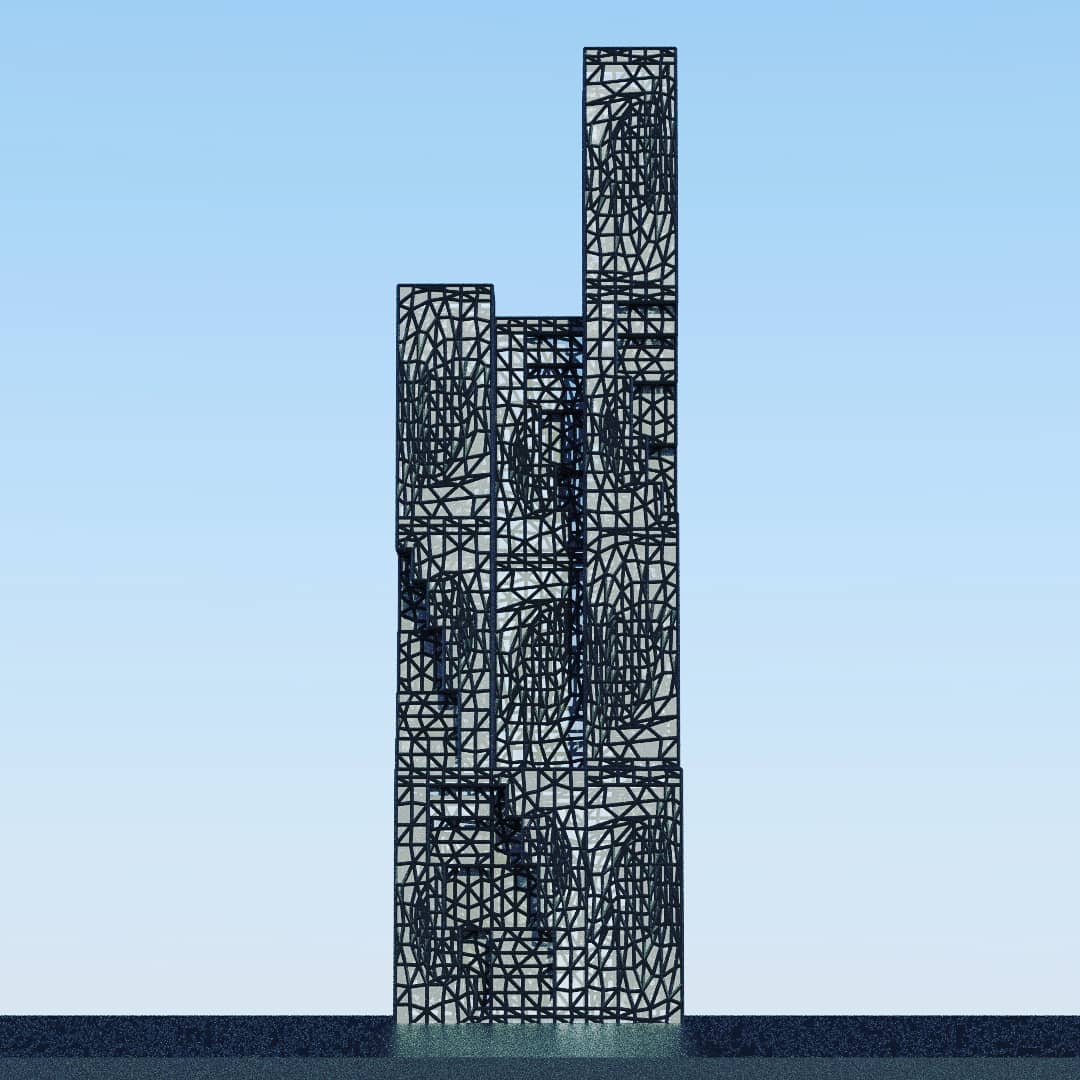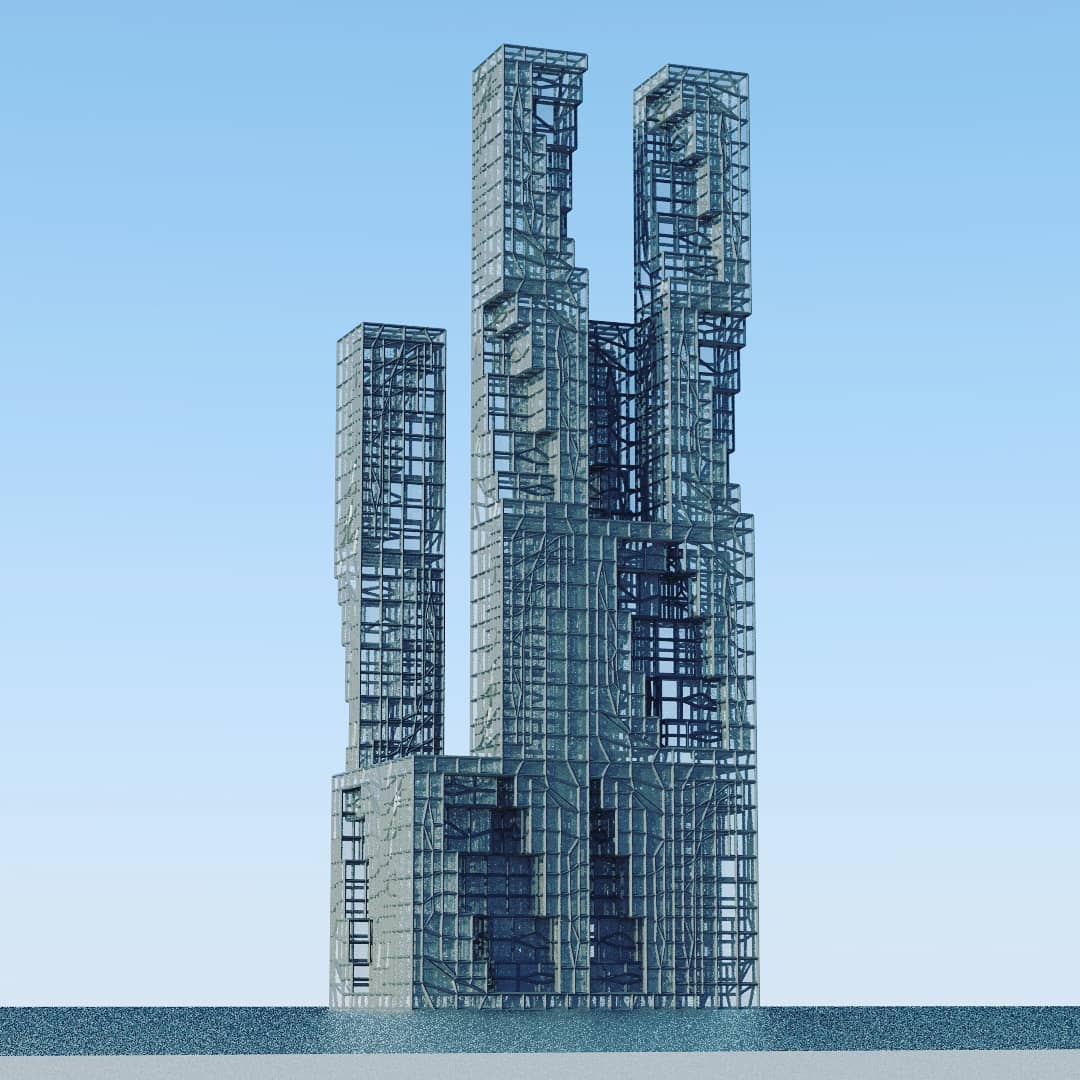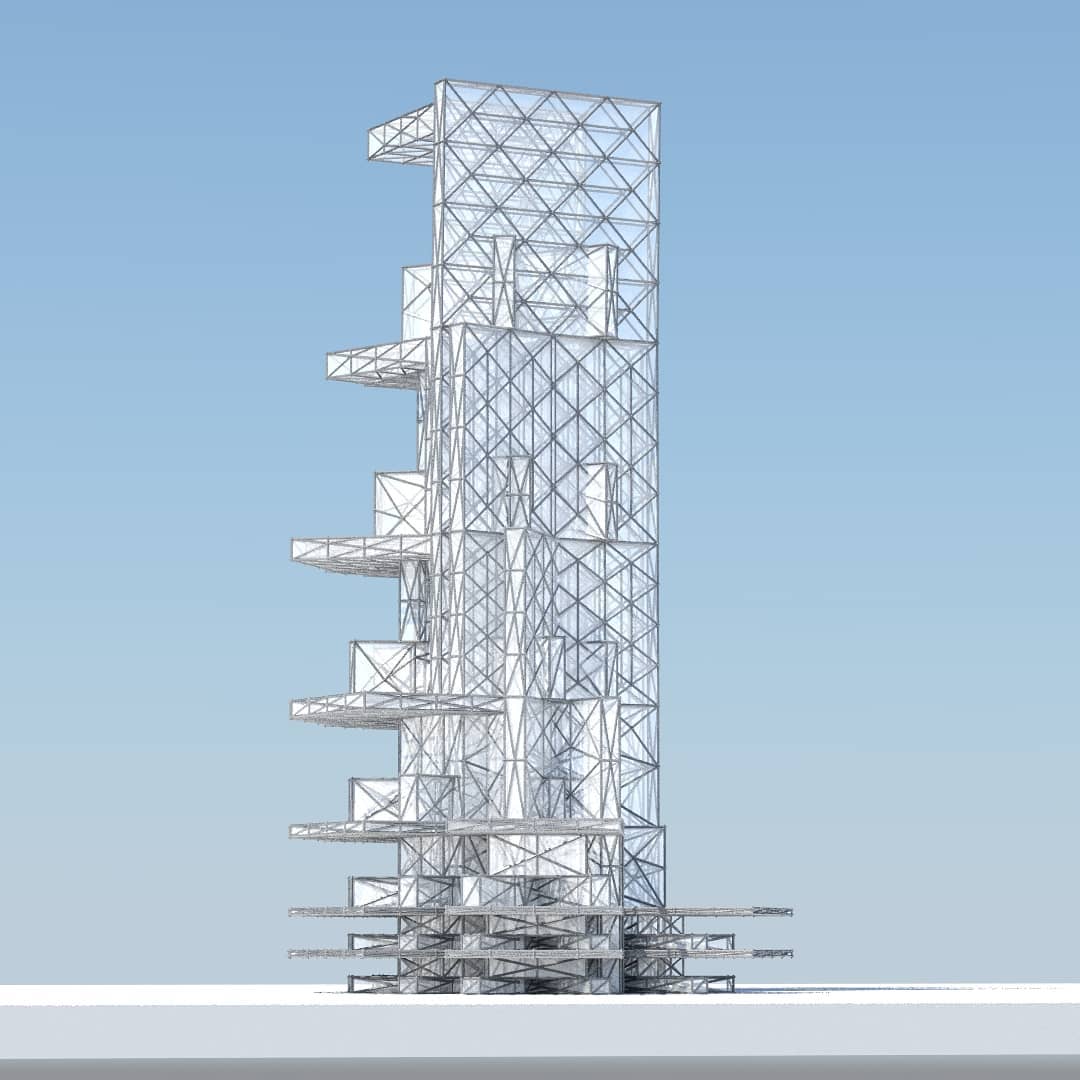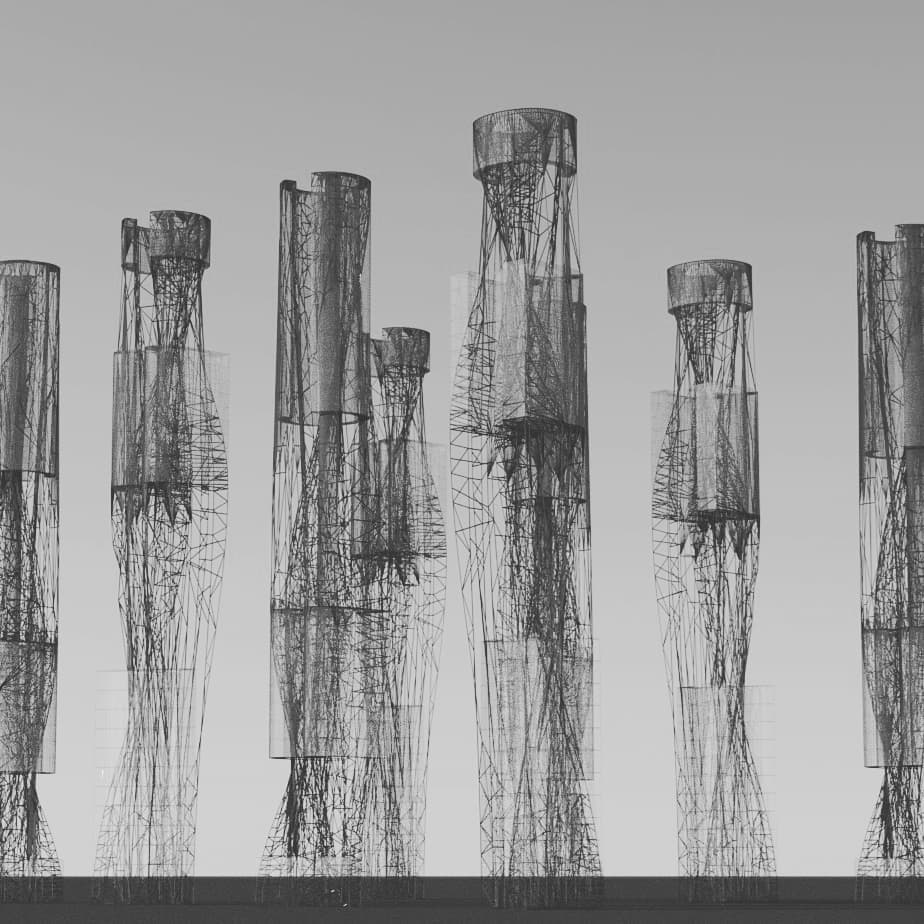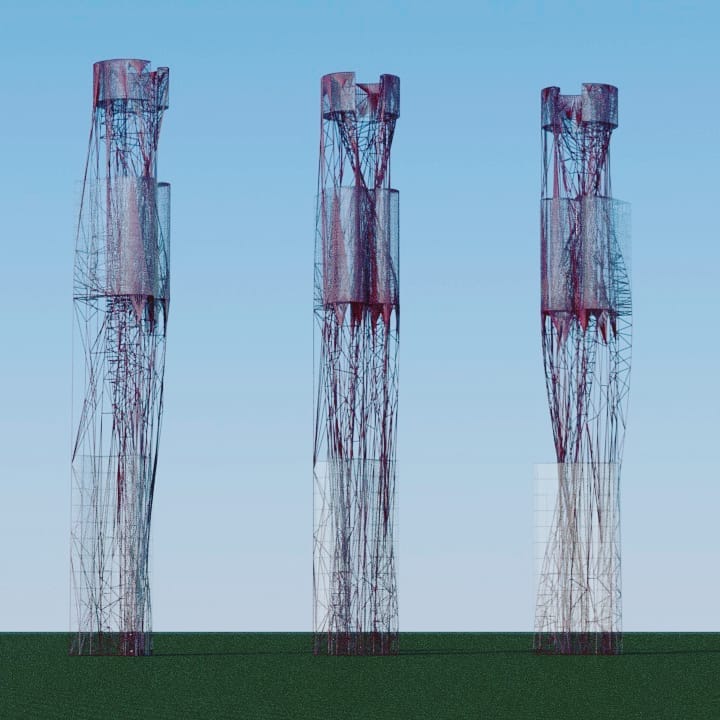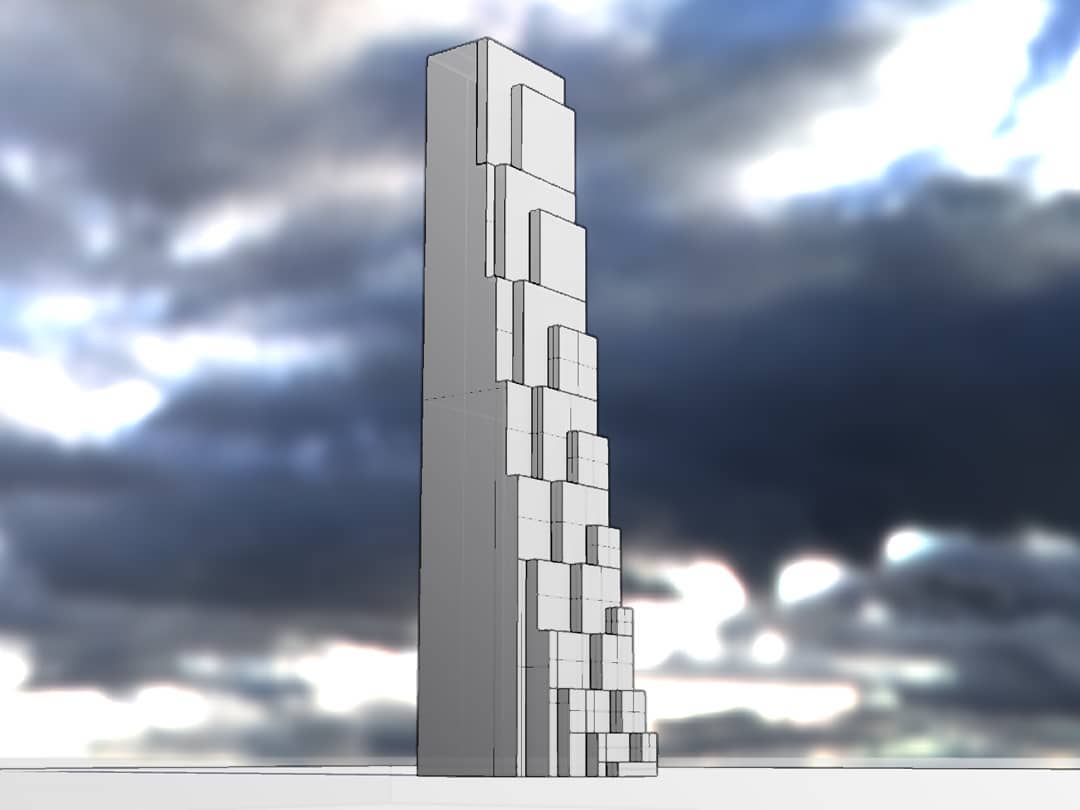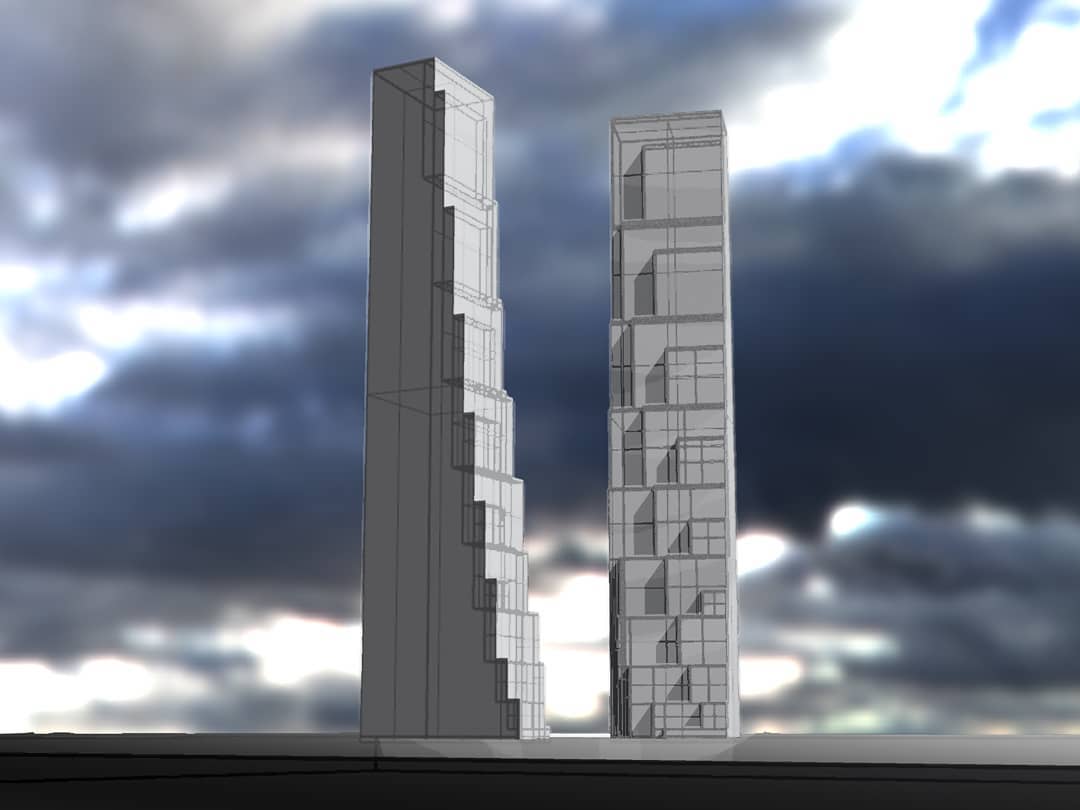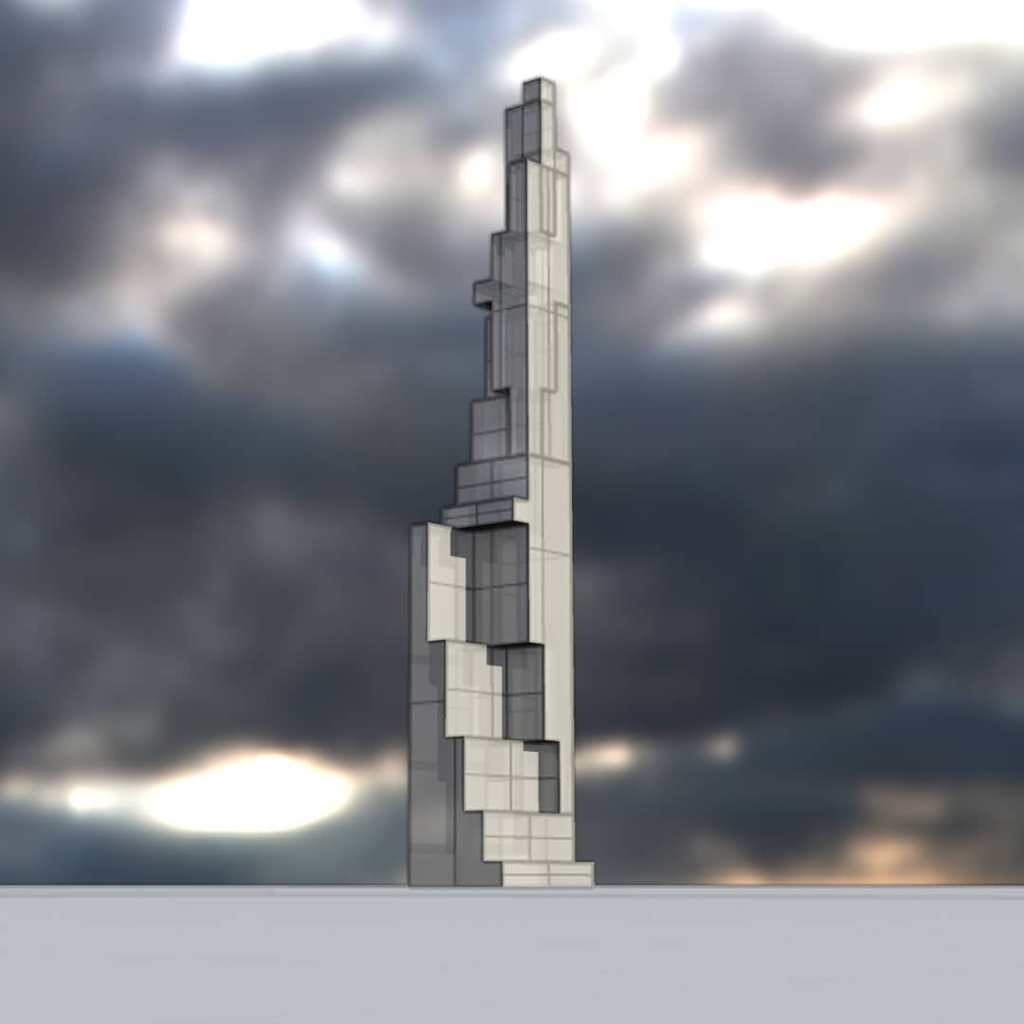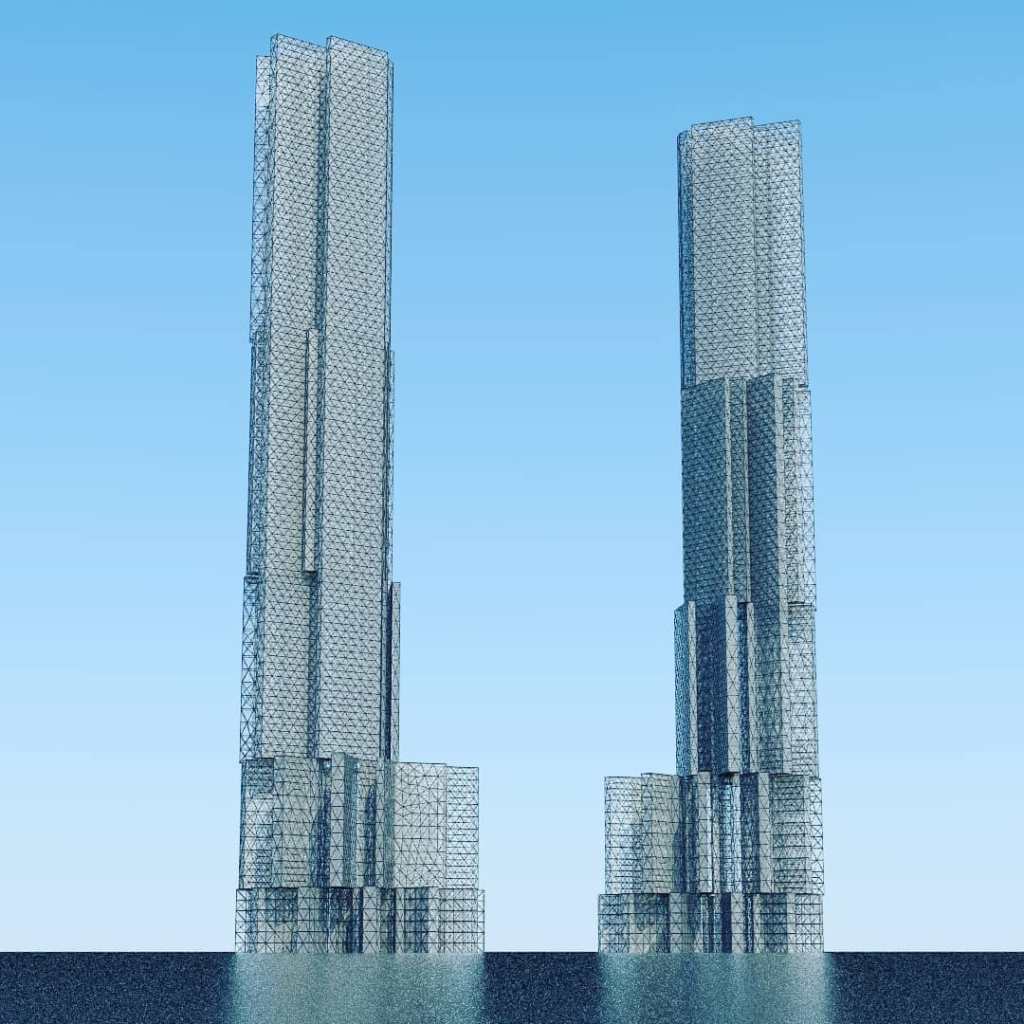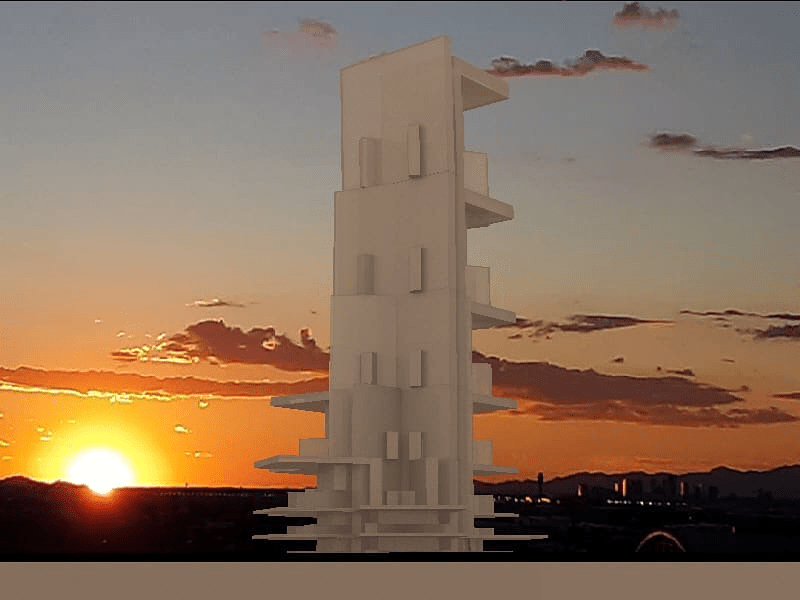
This sequence of drawings were made very quickly at the very end of January and very beginning of February 2019. These should file under “portfolio”. The example above and some below blocks carved out for air and solar exposure. The main tenets that drove these are 1) articulate massing to bring in natural air and solar, 2) variations in the spaces should be apparent in the elevations, 3) brace frames for stability. 4) think lofty and upward. I will add a bit about each tenet, each point below.
Told myself to think tenet not tenement–try to see thoughtful tenets of architecture, any design should strive to be more than a financial tenement of real estate.
1) Light and space are not new ideas, but we should often be reminded of their importance. Could light and space have been the first human ideas? I would nominate them as candidates for that position. We have guidance, zoning codes and plans to build cities with healthy access to life giving light and air. Light and air and space are have been seen as the primary substances of architecture nearly forever.
2) When I draw, I often draw in as many dimensions as possible. I would encourage everyone to do this when appropriate, or. if you are in the position, to teach others to do, if they are in such a position. Do not design from plan view or top down view or z dimension alone, but design in elevation, in the round or in many dimensions as possible. There is a time for drawing in plan only, yes I know. We also need to raise the standard from basic and monotonous to something more vivid.
3) Some of these towers use a diagonal grid, a braced frame structure for extra stability. This might expect you to see the world less through a rectangular window and more of a triangulated or crystalline one. For example,
Who wrote the building code? Tell us more about the authors.
What are their names? Where did they live? How did they live? What else did they do with their lives? What did they build if they knew so much about designing buildings? What else did they write? anything interesting?
I know there have been building codes in the world off and on for ages, in the US here since a little before 1900, maybe longer.
I know the building code is written and revised and there are lots of editions. There is an organization, I know they have a process. I know they have our best interests and safety in mind. I read their work, I enjoy learning it, I trust it.
We have lots of legal documents with interesting authors. We have access to many legislators’ biographies.
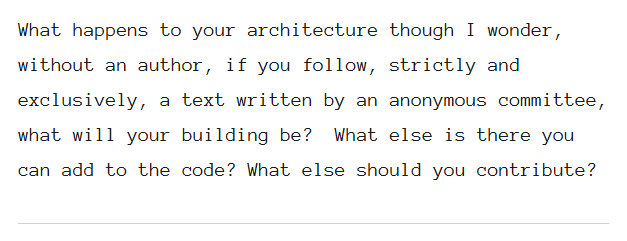
What happens to your architecture though I wonder, without an author, if you follow, strictly and exclusively, a text written by an anonymous committee, what will your building be? What else is there you can add to the code? What else should you contribute?
“[…]that he might really and would surely develop his own characteristic individuality, and that the architectural art with him would certainly become a living form of speech, a natural form of utterance, giving surcease to him and adding treasures great and small to the growing art of the land; […]” -Louis H. Sullivan, 1896.
I have collected quotes on architecture as a language since day one, not sure why or how it all started, exactly. Some strange, some straight forward. I am also interested in language as architecture, so keep that in mind. I finally realized there was more to this notion than Victor Hugo’s or Nikolai Gogol’s puzzling statements, the Sullivan epigraph above, brings it all together. Not only is it a beautiful line by Sullivan, it is intrinsic to the essay that brought us his “form ever follows function” mantra. You may, or may not, get the connection between architecture and language, but I hope it makes some sense to you before this post and my next post. We know architecture, we know language, but soon it will be time to know a compounded notion of the two: ARCHITECTURE AS A FOREIGN LANGUAGE.
BIBLIOGRAPHY
Sullivan, Louis H. “The Tall Office Building, Artistically Considered”. The Inland Architect and News Record. May, 1896. Pp.32-34.
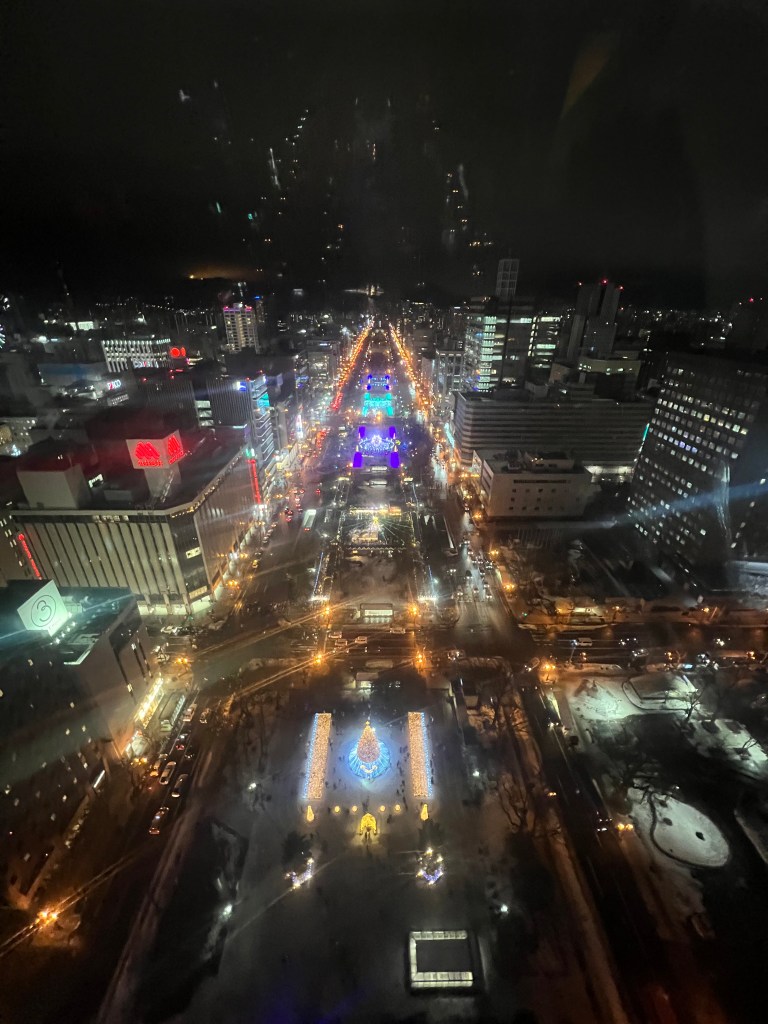
Odori Park From Sapporo TV Tower, Aurora City is Underneath. December 2025. Photo by author.
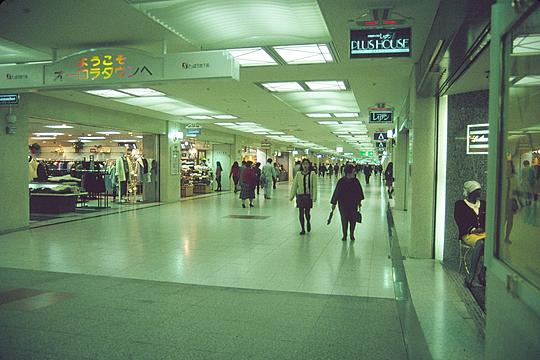
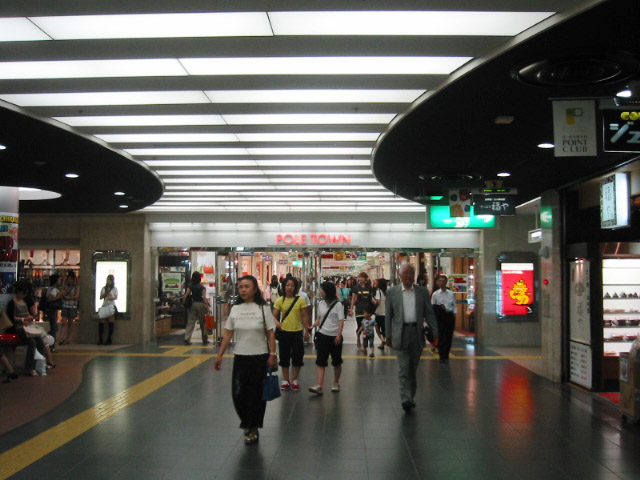
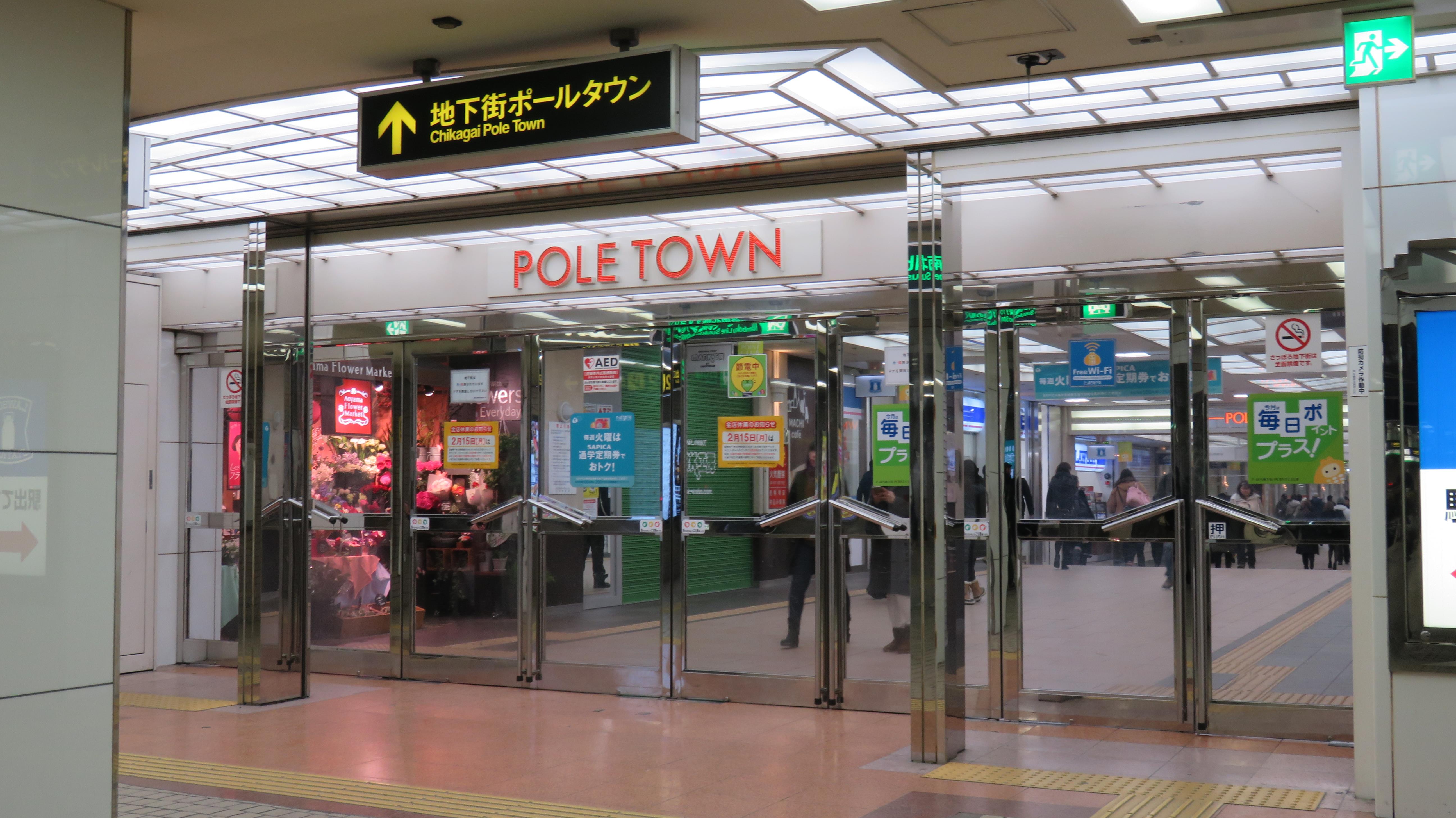
Beneath much of Sapporo is an underground city (the whole underground network is referred to generally as “Chikagai”; one of the walkways is called “Chi-ka-ho’), it is a busy network of shop lined streets in Sapporo’s most central area, Chuo Ward. It is an underground city of substantial size, with around 150,000 visitors per day. One main part is Aurora Town running from Odori Station to the Sapporo TV Tower, under Odori Park. Aurora Town runs East-West. Another main part is Pole Town running beneath Ekimae Dori (Sapporo Station Street) to Susukino Station. Pole Town runs North-South. This underground city was constructed along with the Sapporo Municipal Subway for the 1972 Sapporo Olympics. The total cost, at the time, for urban renewal was 602 billion Japanese Yen. Osaka in 1977 had a comparable but larger underground city than Sapporo, “with a population greater than that of Seattle and Denver combined”. The development of underground spaces was a nation wide effort in 1970s Japan, and is a characteristic feature of urban development in Sapporo, a major city located in mostly cold and snow covered Hokkaido.
The widening of Ekimae Street, in Spring 1964, prompted the initiative for the underground city. There was a concern that seniors and young children would not have time to cross the wide street in a single crosswalk cycle, and a safe elevated or underground passageway idea was discussed. When Sapporo was chosen to host the 1972 Winter Olympics, the concept of the underground passageway gained momentum, and proponents realized it needed to be built along with the subway in order to be feasible. A group of shareholders and advocates lobbied the Ministry of Construction, and the Ministry formed a council on the topic guiding it to fruition. The Ministry of Construction facilitated a public corporation to build and operate the underground malls and they added enough parking to the program. The project began and was completed in just 1.5 years, with the underground city opening on 11-16-1971 at 11:16am, one year before the Sapporo Olympics.
Aurora Town previously featured waterworks of fountains, river and waterfall that were removed in 1980 due to congestion. The “river” was named “River of Joy” and was 40m long with 160 fountains.
Pole Town and the “Chi-ka-ho” passageway are nearly 2km long making for the one of the longest (if not the longest) underground tunnel straight distance in all of Japan.
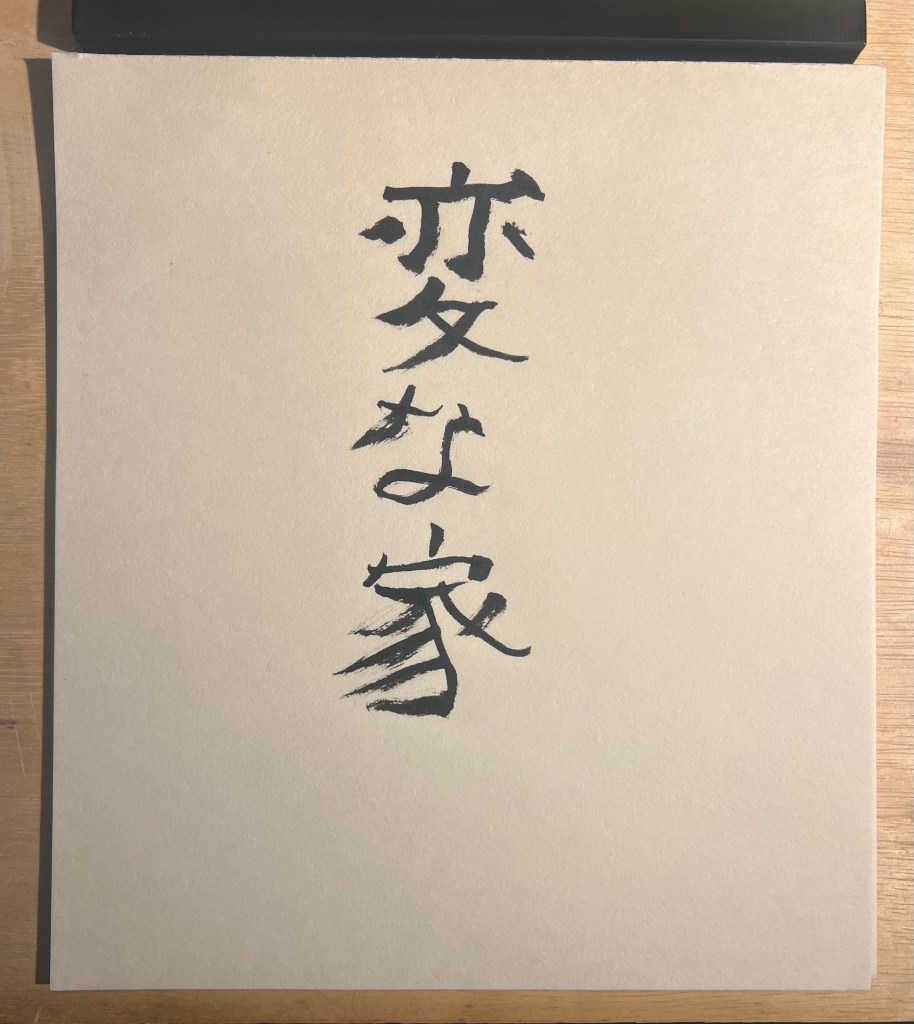
変な家 “Strange Houses” is a recent Japanese novel, manga and movie.
I saw a mention of it online and it instantly caught my attention, with just an image with a house plan and an air of suspense and mystery. I decided quickly to review it, after reading a few more overview and publicity items. I have not read anything in suspense or horror genres for a while, but I read architecture everyday.
Before you get to my review, I am putting the sources first so you can investigate or yourself. Do not be scared. Read and watch in your preferred format and language. Let me know what you think. I know I will revisit these and explore further.
The author, Uketsu, has a strong YouTube presence, apparently this is how these stories all began:
Here is a sample with automatically generated English subtitles and overdubs:
変な絵 “Strange Pictures” 変な地図 “Strange Maps” are also available.
There are some detective precedents and parallels, on some level “this “Strange Houses” is a sophisticated updated haunted house story, in full command of the secret passageway trope. There are Romantic and Victorian gothic echoes in the curses of heredity and architectural implications of the events described. The thought processes are meticulously logical, almost to excess, and this casts the author and architect duo as a kind of Holmes and Watson, at times. Overall the translation is completely readable and accessible, conveying scares and fears that are updated to our times.
REVIEW
The story raises questions about history. What is a house’s past life? And as a consequence, what is its death?
The simplicity of the modern house plan is not simple enough. Raises more questions about simplicity and what might seem generic. Real estate listings abound in Japan and realtor windows and publications display the flooded market of plans. A terrifying plot weaves through the slew of vacant homes portrayed in the surplus floor plans. These ordinary houses, at first glance, after further inspection tell countless stories and mysteries from mundane to the most horrific.
READING OR READING INTO SOMETHING
You may wonder throughout, as I did, are the author and draftsman reading or reading into the plans?
The book starts so simple and clear with monologue and dialogue.
Reading requires a certain suspension of disbelief.
Towards the end, the book goes from architectural to genealogical and perhaps is easier to read for some. The intricacies of family trees may be hard to follow for those inclined to the floor plans, and vice versa. The motives stem from a generational inheritance of a deadly oath and rivalries over the family fortune. Kurihawa’s final word is a discourse on authorship, details, speculation and proof. The Afterword’s monologue on inclusion of proof can be rephrased as “reading” and “reading into” where what is included is “read” and what is speculated is “read into”.
The “mysterious dead space” triggers all the suspicions, something about unused, inaccessible, unknown space that makes the imagination wander.
AFTERWORD
After finishing the first book and writing this mid-review, I actually travelled in Japan for 10 days. Just posted it now, after adding that finishing touch of my amateur calligraphy at the top. I had asked a Japanese friend about the book and she was reading these too, while travelling, she gave me a copy of “Strange Maps” which has not been translated into English yet. I have been skimming it and it has a lot of interesting imagery, trying to decode it but will wait until the whole book is translated.
変な家 “Strange House” is a recent Japanese novel, manga and movie.
I saw something for it online and it caught my attention, an image with a house plan and an air of suspense and mystery. I decided quickly to review it, after reading a few more overview and publicity items.
I sent away for copies of the novel and manga from Kinokuniya, here’s the link if you would like to do so too, just search “変な家”:
I am also watching the video series on YouTube, I read that the author, Uketsu, has a strong YouTube presence:
Here is a sample with automatically generated English subtitles and overdubs:
I am about halfway done with the English edition and have watched about 45 minutes of the video. Next up I will post my “Strange House” mid-review, called: READING, OR READING INTO.
This is a quick review of the exhibition offerings at Scottsdale Museum of Contemporary Art (SMOCA), written on October 31, 2025.
I visited the museum, yesterday, on the weekly “pay as you will day” Thursday after a month or two without visiting. I was impressed to the point of deciding to write about the art on display.
What was first noticeable was a window decal by the main entry, instantly recognizable to this eternal architecture student, as the solar path diagram for Phoenix at approximately 32 degrees north. A little research will remind the reader, that a device called a “Sun Angle Calculator” featuring this diagram (without analemmas) was in production in 1951 by the Libby Owens Ford Company, and variants were used extensively in the solar design books by Olgyay in the 1950s-60s. These were further cemented in generations of architects’ training by the Graphics Standards editions printed from then through the the next 75 years. This window decal stayed with me like a compass as I viewed and was impressed by the rest of the museum’s work, and I decided to go back the next day to write.
When I returned to review I took further note of Evan Roth’s work, there were more sun path inspired works but they were more evocative and artful than the basic template decal. The lobby was lined with draped fabrics with solar or celestial tracings in their stitching. The most appealing to me had traces of horizon and perspective, such as “Old Town and Littrow” of 2025. I thought at first there was some wash of colorful dye on the cotton but it is a digital print of sky coloration, I read. There a few celestial paths were traced, or perhaps the sun at several times in a year then combined.
A digital kiosk showed Roth’s experiment with a solar path smartphone app, which I have also tried and recognized as a result of these explorations. Roth designed an immersive digital film, Pathfinding, in the screening room by the lobby. The film, as usual for me, was a little harder to understand and more of a mood or vibe to sit and soak in, as an immersion.
I asked about curation and overarching themes for the exhibitions at the reception area and was told this Summer-Fall work showing until February, was curated by a few individuals, and they are listed in the fine print on the statement for each artist. Julie Ganas curated the work of Evan Roth, and I noticed Ganas also curated the work by Casey Curran, Tidal Sky, which I will address next.
On my first visit I walked briskly through the Tidal Sky gallery and the work did not register until one of the docents suggested I twirl one of the handles on the work. (see illustration) Unfortunately, I cannot post video on this web log, would be nice to show you how the work has very subtle and charming movements.
What is nice about the work is that it is instructional to the extent that once that handle is twirled and the magic is set in motion, you can still understand exactly how it operates. My words can assist, you should see it for yourself, and learn firsthand. Most of the reliefs feature skeletal animals fancifully reinvented and animated by marionette like mechanisms. Like these gilded, flying and floating natural history specimens, the skeletons of their controls, their inner workings are revealed, as if to say, “here is how you do this” yet the fine detailing is such that one would not easily be inclined to attempt to recreate them for fear of failing to accomplish such high quality. They are music boxes in the simplicity of activation, yet without boxes so you can see how every movement is created, also without music for that matter, they are set in motion with a rotational turn of a handle, more like automata.
Jeanne K. Simmons’s Rooted, shows artifacts and photographs of forest and ocean settings, with a woman enshrouded in clothes made of natural materials. For instance, there are images of a woman in the woods cloaked in a cloth made of bark tiles sewn together. Or there is a woman perched above on a small cliff, in a fifteen foot long streaming cotton shirt, flowing in strands downward like water, to below. Or a woman is mermaid-seeming, swimming in the ocean in a dress made of kelp leaf strands. Or the woman is in a skirt sewn of twig branches. Some clothing items made of Nature that the woman is photographed in are present in the gallery.
James Perkins’s Burying Painting, took a minute to appreciate. The objects are in a large space with some distance between. I did not develop an understanding quickly, but after the second viewing the title sinks in and the videos helped me make sense of it. The artist used a process of digging into sites, then put stretched fabric on a frame in or on the Earth to render the image. Nature’s pigment from the ground and even coyote contribution of tearing the fabric into tatters, make these unique and grounded in our Planet. Most of the works are silks on wooden frames, with that signature luster only from silk altered by Nature and the artist’s process.
I was worried about the photosensitivity warning outside Squidsoup Infinite at my first visit, but on the second time I spent more time and I enjoyed the experience. The audio-visual orbs are spaced enough and visible enough in the darkness that I walked to the center of the room and took it in for a few minutes.
Began the day with a dry erase session, looking for ways to maximize surface, all the while, also thinking about ways of self shading, as I often do while thinking of conditions in Phoenix.
Two main findings: 1) a motif I have explored before–mitochondrial edges to maximize surface-only with those arranged internally to avoid direct light and heat gain. 2) egg-like structures with a hardened shell, and open to light, views, and outside space on the inside.
Developed the second idea little which I call “Birth of a Phoenix”– will work on drafting some iterations of the first idea sometime later.
As usual I simplified the dry erase sketch in my photo editor, for cleaner printing.
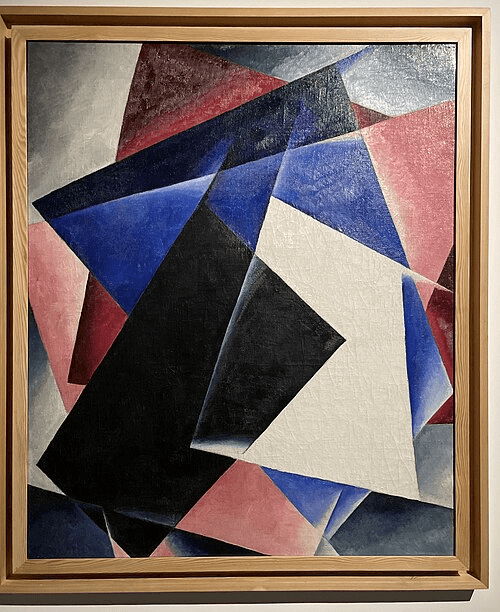
Archimedes’ Stomachion, Liubov Popova’s Paintings c.1918, and Depth Maps c.2018
Have recently been reading Lucretius, On the Nature of Things, and there is quite a lot in there to process. Works from antiquity are often overwhelming and enthralling. Replete with arcane ideas, references and things– I have missed on my journey so far and feel the need to follow up with. One such thing is Archimedes’ Stomachion, an antique masterpiece of geometrical abstraction. Remind me to compare it more formally and analytically to Popova’s Architectonics c.1918 and other triangular abstractions of the early 20th century.
In May of 2018, I was finishing a Masters of Architecture degree and was soon to join a program for a Doctorate of Philosophy in design. All indications at the time pointed to a PhD project on avantgarde and modern art, design, and architecture in the early Soviet Union. I had payed a lot of attention to Liubov Popova in my readings. Her story and imagery were impressive and intriguing, especially any “Живописная Архитекектоника” (Painterly Architectonic) — as that phase combined art and architecture with the possibilities and mysteries of trigonometric space.
That May, and for the few years after, I was testing several approaches to my doctorate. And testing a few and fulfilling other lines of inquiry. Would I work on some kind of building science? Visual analysis? Interviewing, surveying, and polling? I settled on a historical-philological path and tread as lightly as possible. One incomplete line of inquiry was a project I called “Depth Maps” that were intended to generate depth from abstract two dimensional works. I used three of Popova’s Architectonics and ran them through some software to generate as such. The basic principal is seeing in grayscale and mapping by tonal range, assign minimum to white and maximum depth to black (or vice versa) and plotting all points of gray in between.
This month, October of 2025 I appreciate and realize more than before how important of a precedent Popova’s works are and how my efforts at Depth Maps, seven years before, are an point of departure for my recent efforts at developing a Drawing to Print method that adds depth to a two dimensional drawing.