
(to the depths of the phrase “research applicable design criteria”)
AIA B101-2017 is the standard contract between the architect and client (or owner). Before describing the architect’s work in the main phases of design, the first point in the architect’s scope is:
“§ 3.1.1 The Architect shall manage the Architect’s services, research applicable design criteria, attend Project meetings, communicate with members of the Project team, and report progress to the Owner.”
§ 3.1.1 is the introduction of the scope of services leading into the basic services the architect is to perform. Besides the rest– the management, meetings, communications, and reports– most interesting to me is the research. According to this section, research is required of architects in their AIA contracts, early, right away, and then throughout the project. Research begins here, before the first phase and it is not limited to any of the phases. It is principally limited by “applicable criteria”.
While research is mentioned sparingly in the AIA materials (perhaps since it is more in the realm of professors than professionals), I wrote briefly about its inclusion in the Code of Ethics, in “Reasons For Research, Memo 1”. I am comfortable with what research is and what can be, as well as design, I am going to dig into the other terms for the purpose of this post.
We need to find out what is “applicable” or what can be applied to the design.
Oxford English Dictionary, by way of internet search, reveals this:
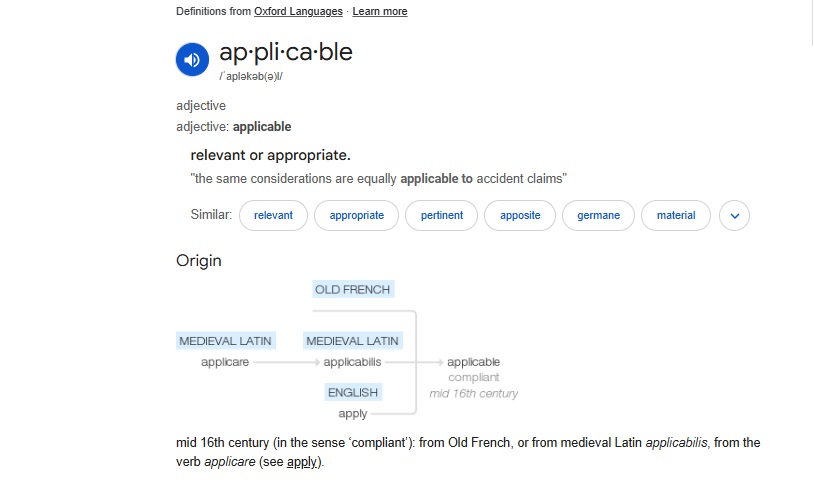
These meanings of ‘compliant’ and synonyms ‘relevant’ ‘ appropriate’ reign in the design and require it to be guided so that it is [code] compliant, [politically] relevant, and [situationally] appropriate. That is all fine and reasonable, and adequately open ended. Trying to make sense of this. What else could applicable imply in design, perhaps that the architect will research ways for the design to meet the client’s expectations and be economical, structural, and appealing.
To further understand this section of the B101, and what we will need to research, we need to find out what and which “criteria” are involved and able to be applied.
Oxford English Dictionary by way of internet search, reveals this

This is the more foreboding term, seeing that a criterion is essentially a critique or some kind of judgement. Critique or judgement can range from an opinion in passing to an opinion with a lot of traction. There are many obligations at play here, many many criteria. The research delves into applied judgement of critical authority. The obvious place to look, when it comes to judgement is the authorities having jurisdiction over the project. They issue permits according to building codes designed to secure health, safety, and welfare of the public. There are also planning zones and districts with their requirements as well as some contractual criteria such as covenants. The Code of Ethics also has some bearing here, as the architect and the public, client, profession, colleagues, and environment are all in critical positions through obligations with some form of say or what can be considered capacity for judgement. The architect thus maintains a whole host of rapports and beneficial considerations for a harmless critique. So the architect’s research, set in motion and required by § 3.1.1, is to the depths of all of these that apply, and to balance their levels of relevance and garner favorable judgement and critique.
It is likely that I am trying to read this four word phrase a little too closely. The simplest most concise way of reading “research applicable design criteria” and knowing what to do, is to find ways to harmonize design, tuned to as many people and factors involved, as possible.
Lead illustration source: Borgoyne, Alan Hughes; Submarine Navigation Past and Present. London: G. Richards, 1903. Vol. 1, p.107. https://catalog.hathitrust.org/Record/001624061
May 28, 2025
 drdrr.work