This is a quick review of the exhibition offerings at Scottsdale Museum of Contemporary Art (SMOCA), written on October 31, 2025.
I visited the museum, yesterday, on the weekly “pay as you will day” Thursday after a month or two without visiting. I was impressed to the point of deciding to write about the art on display.
What was first noticeable was a window decal by the main entry, instantly recognizable to this eternal architecture student, as the solar path diagram for Phoenix at approximately 32 degrees north. A little research will remind the reader, that a device called a “Sun Angle Calculator” featuring this diagram (without analemmas) was in production in 1951 by the Libby Owens Ford Company, and variants were used extensively in the solar design books by Olgyay in the 1950s-60s. These were further cemented in generations of architects’ training by the Graphics Standards editions printed from then through the the next 75 years. This window decal stayed with me like a compass as I viewed and was impressed by the rest of the museum’s work, and I decided to go back the next day to write.

When I returned to review I took further note of Evan Roth’s work, there were more sun path inspired works but they were more evocative and artful than the basic template decal. The lobby was lined with draped fabrics with solar or celestial tracings in their stitching. The most appealing to me had traces of horizon and perspective, such as “Old Town and Littrow” of 2025. I thought at first there was some wash of colorful dye on the cotton but it is a digital print of sky coloration, I read. There a few celestial paths were traced, or perhaps the sun at several times in a year then combined.
A digital kiosk showed Roth’s experiment with a solar path smartphone app, which I have also tried and recognized as a result of these explorations. Roth designed an immersive digital film, Pathfinding, in the screening room by the lobby. The film, as usual for me, was a little harder to understand and more of a mood or vibe to sit and soak in, as an immersion.

I asked about curation and overarching themes for the exhibitions at the reception area and was told this Summer-Fall work showing until February, was curated by a few individuals, and they are listed in the fine print on the statement for each artist. Julie Ganas curated the work of Evan Roth, and I noticed Ganas also curated the work by Casey Curran, Tidal Sky, which I will address next.
On my first visit I walked briskly through the Tidal Sky gallery and the work did not register until one of the docents suggested I twirl one of the handles on the work. (see illustration) Unfortunately, I cannot post video on this web log, would be nice to show you how the work has very subtle and charming movements.
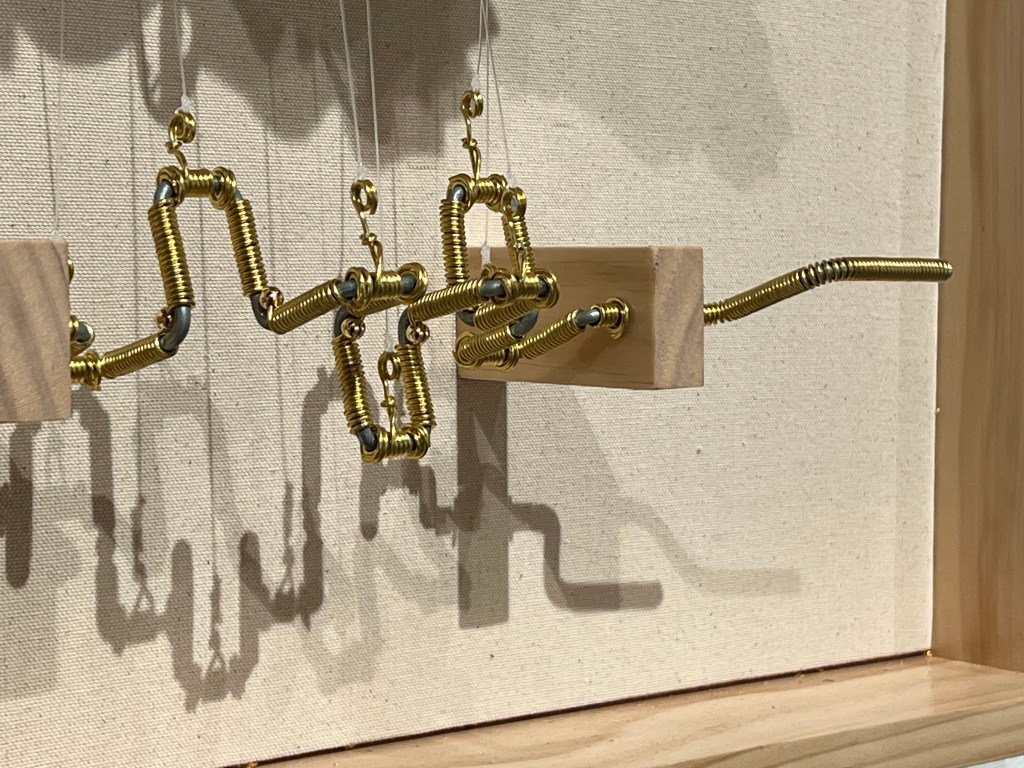
What is nice about the work is that it is instructional to the extent that once that handle is twirled and the magic is set in motion, you can still understand exactly how it operates. My words can assist, you should see it for yourself, and learn firsthand. Most of the reliefs feature skeletal animals fancifully reinvented and animated by marionette like mechanisms. Like these gilded, flying and floating natural history specimens, the skeletons of their controls, their inner workings are revealed, as if to say, “here is how you do this” yet the fine detailing is such that one would not easily be inclined to attempt to recreate them for fear of failing to accomplish such high quality. They are music boxes in the simplicity of activation, yet without boxes so you can see how every movement is created, also without music for that matter, they are set in motion with a rotational turn of a handle, more like automata.

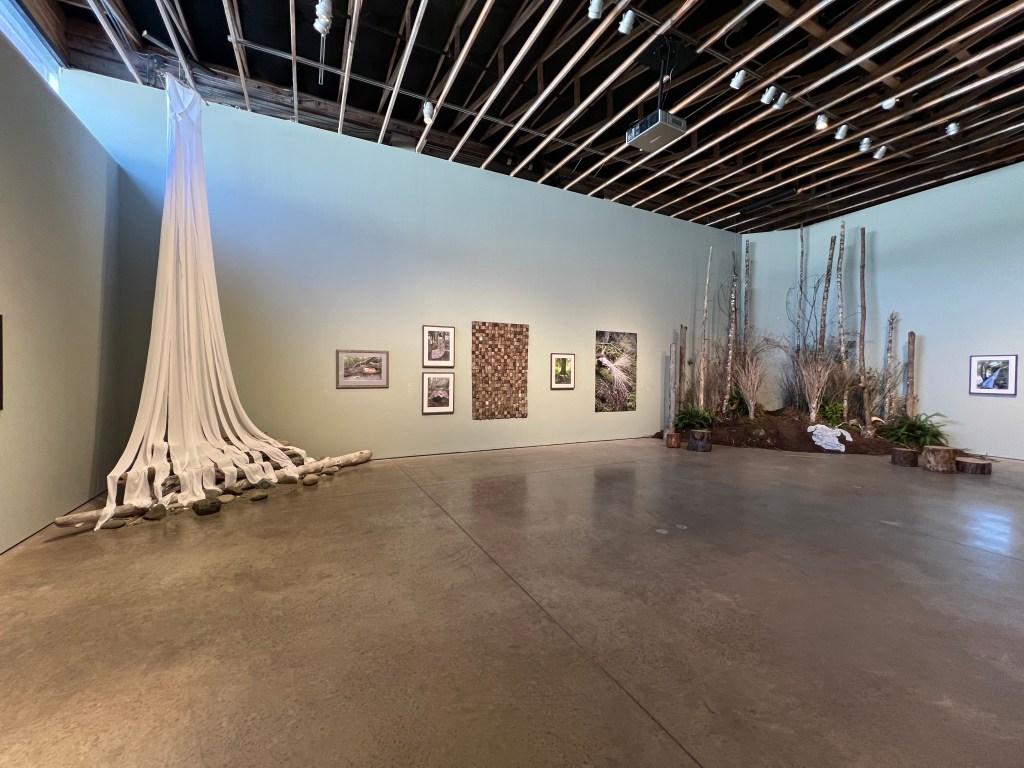
Jeanne K. Simmons’s Rooted, shows artifacts and photographs of forest and ocean settings, with a woman enshrouded in clothes made of natural materials. For instance, there are images of a woman in the woods cloaked in a cloth made of bark tiles sewn together. Or there is a woman perched above on a small cliff, in a fifteen foot long streaming cotton shirt, flowing in strands downward like water, to below. Or a woman is mermaid-seeming, swimming in the ocean in a dress made of kelp leaf strands. Or the woman is in a skirt sewn of twig branches. Some clothing items made of Nature that the woman is photographed in are present in the gallery.
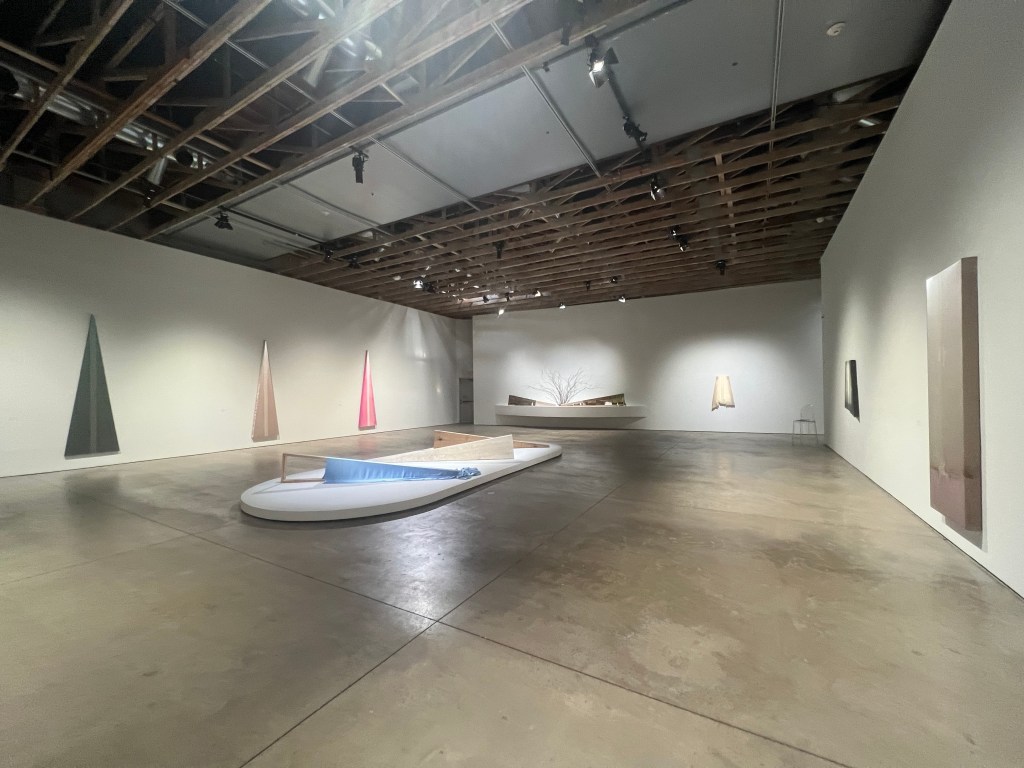
James Perkins’s Burying Painting, took a minute to appreciate. The objects are in a large space with some distance between. I did not develop an understanding quickly, but after the second viewing the title sinks in and the videos helped me make sense of it. The artist used a process of digging into sites, then put stretched fabric on a frame in or on the Earth to render the image. Nature’s pigment from the ground and even coyote contribution of tearing the fabric into tatters, make these unique and grounded in our Planet. Most of the works are silks on wooden frames, with that signature luster only from silk altered by Nature and the artist’s process.
I was worried about the photosensitivity warning outside Squidsoup Infinite at my first visit, but on the second time I spent more time and I enjoyed the experience. The audio-visual orbs are spaced enough and visible enough in the darkness that I walked to the center of the room and took it in for a few minutes.

Three word conclusion: see for yourself.
 drdrr.work