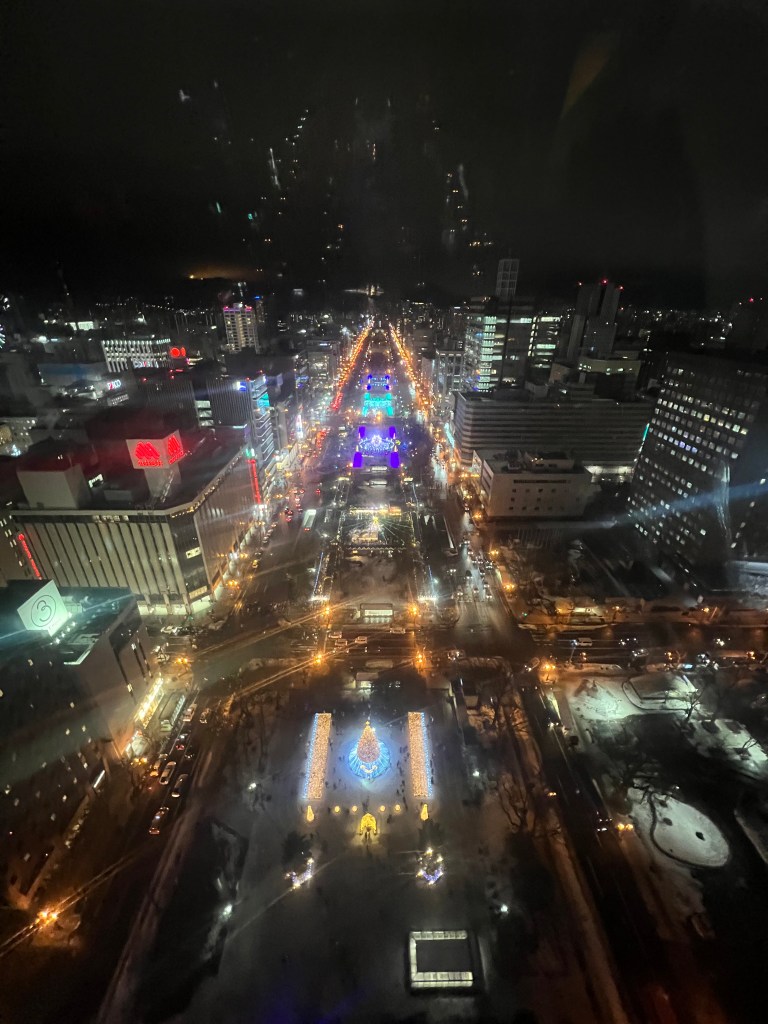
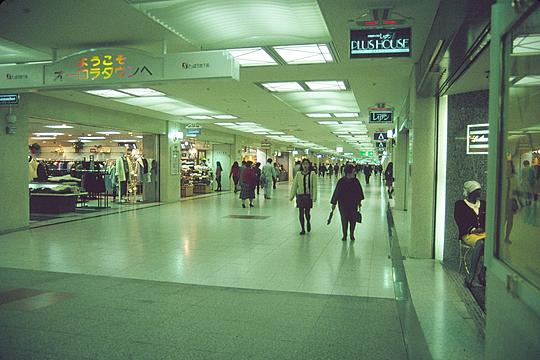
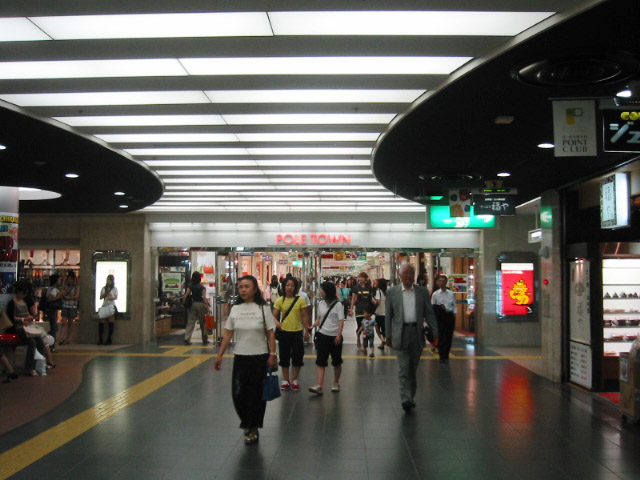
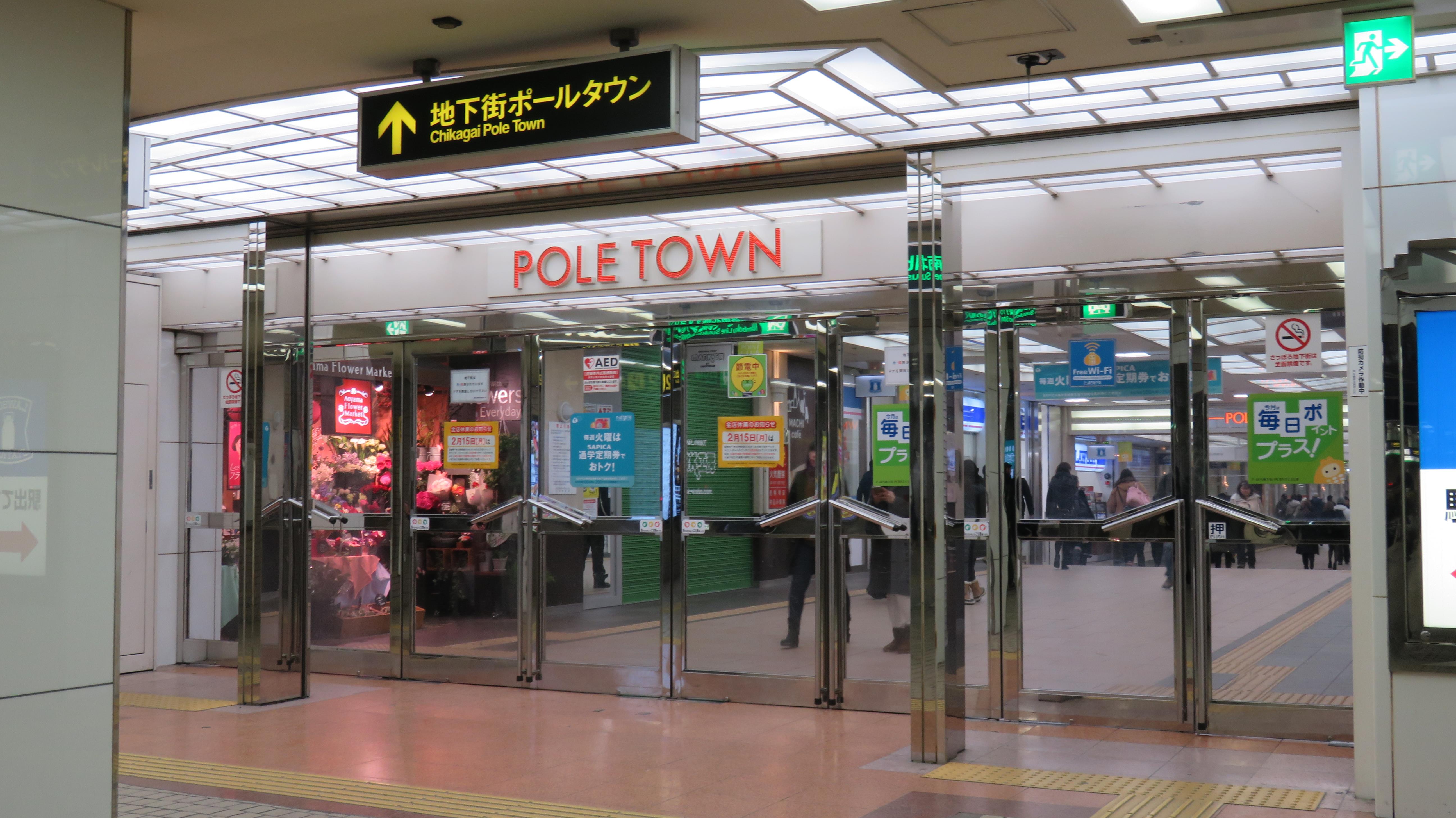
Beneath much of Sapporo is an underground city (the whole underground network is referred to generally as “Chikagai”; one of the walkways is called “Chi-ka-ho’), it is a busy network of shop lined streets in Sapporo’s most central area, Chuo Ward. It is an underground city of substantial size, with around 150,000 visitors per day. One main part is Aurora Town running from Odori Station to the Sapporo TV Tower, under Odori Park. Aurora Town runs East-West. Another main part is Pole Town running beneath Ekimae Dori (Sapporo Station Street) to Susukino Station. Pole Town runs North-South. This underground city was constructed along with the Sapporo Municipal Subway for the 1972 Sapporo Olympics. The total cost, at the time, for urban renewal was 602 billion Japanese Yen. Osaka in 1977 had a comparable but larger underground city than Sapporo, “with a population greater than that of Seattle and Denver combined”. The development of underground spaces was a nation wide effort in 1970s Japan, and is a characteristic feature of urban development in Sapporo, a major city located in mostly cold and snow covered Hokkaido.
The widening of Ekimae Street, in Spring 1964, prompted the initiative for the underground city. There was a concern that seniors and young children would not have time to cross the wide street in a single crosswalk cycle, and a safe elevated or underground passageway idea was discussed. When Sapporo was chosen to host the 1972 Winter Olympics, the concept of the underground passageway gained momentum, and proponents realized it needed to be built along with the subway in order to be feasible. A group of shareholders and advocates lobbied the Ministry of Construction, and the Ministry formed a council on the topic guiding it to fruition. The Ministry of Construction facilitated a public corporation to build and operate the underground malls and they added enough parking to the program. The project began and was completed in just 1.5 years, with the underground city opening on 11-16-1971 at 11:16am, one year before the Sapporo Olympics.
Aurora Town previously featured waterworks of fountains, river and waterfall that were removed in 1980 due to congestion. The “river” was named “River of Joy” and was 40m long with 160 fountains.
Pole Town and the “Chi-ka-ho” passageway are nearly 2km long making for the one of the longest (if not the longest) underground tunnel straight distance in all of Japan.
REFERENCES
Wikipedia: “さっぽろ地下街”, https://ja.wikipedia.org/wiki/さっぽろ地下街, accessed 1/19/2026.
Wikimedia images in tiled gallery:
Aurora Town, 1992
https://commons.wikimedia.org/wiki/File:Aurora_Town_of_Sapporo_Chikagai_-underneath_Odori_Park(1992-10_by_sodai-gomi).jpg
Pole Town, 2007
https://commons.wikimedia.org/wiki/Category:Underground_cities_in_Sapporo#/media/File:POLE_TOWN.jpg
Pole Town, 2016
https://commons.wikimedia.org/wiki/File:Susukino_Chikagai.JPG
Youtube: STV footage from the construction and inaugural years.
Olympics.com:
According to the Olympics website, the underground city has 150,000 shoppers visit per day.
https://www.olympics.com/ioc/news/an-underground-city
According to the Olympics website, Japan spent 602 billion JPY on Sapporo urban renewal for the 1972 Winter Olympics.
https://www.olympics.com/ioc/news/a-new-transport-infrastructure
The New York Times:
Sterba, James P. ”Japanese Dig In to Refurbish Cluttered Sapporo for Winter Olympic Games”. The New York Times. Nov. 7, 1971.
Lee, John M. “Sapporo: Modern Japan, Frontier Spirit”. The New York Times. Feb. 8, 1972.
Malcolm, Andrew H. “Japan Going Underground With Vast Shopping Complexes”. The New York Times. March 9, 1977.
 drdrr.work
.jpg)

