The site I visited and decided to write about was Kiyomizudera (Japanese: 清水寺 or translated into English: clear water temple). It is an interesting area for many reasons, one of which is that it is as old as Kyoto1 (over a millennium old former capital of Japan), as well as a Buddhist temple complex that is appreciated by various sects,2 and a unique and moving experience surrounded in absolute darkness in one area of the temple.3
The ascent up to Kiyomizudera began in a normal part of the city and went fairly directly for miles upwards most the way. We climbed through the shop-lined city then up a steeper hill and onto the temple grounds through a park. Along the way were other shrines and temples, crowds of worshippers
and tourists, orange-red pagoda balancing elegantly, painted wood joinery, age-darkened wood. This area was more meandering, due to mindfulness towards the mobility difficulties of some of our party we took ramps winding around the edges rather than the stairs in the middle. We passed charming baby-sized stones adorned with handknit bibs in one area and hand knit head caps in another. (NB: These are called Jizo statues, very charming, learned the term later) Next were ponds and temples surrounded in ponds. Several hand cleansing basins (手水鉢) were along this route, and we washed with their elaborate shining ladles. Finally we arrived at an overlook above everything else. The main temple was being restored, not sure what the planned changes or restorations entail. Along the first side of the temple was our main destination. At this point we were instructed to place our shoes in plastic handbags and read instructions before heading inside.
The instructions mainly concerned how to proceed and how to make a wish at the Buddhist stone deep beneath the temple. I bid (a temporary) farewell to the visible world and went down the stairs. Light faded to all-encompasing darkness. I just closed my eyes or kept them open, it was the same. Adjusting
to the pitch black I could see a dark blue or purple marbled pattern on my retinas, the marbling sensation was like the suminagashi (墨 流 し) process where ink is floated on water then paper soaks in it. When my eyes no longer served me, my auditory and tactile senses became the guides. I could hear the rustle of the bag with my shoes, as well as others’ shoe bags in the room. I could feel the beads along the handrail. They were similar to the beads on a Buddist bead bracelet but were much larger, about the size of a fist. I kept one arm extended so that I would not run into the person in front of me with my face.
I kept thinking of my wish.
After one final turn there was light. A pointed spotlight type of illumination (I could not see or recognize the source) shone on the stone described in the instructions and bearing a Sanskrit resembling the number 4 to me,4 I could see the Buddhist letter and other hands making wishes on the stone but the luminance had such a short falloff that I could not see up their arms to their faces. I placed my hands as well and made my wish. Then I went towards louder noises that were from an upper level up stairs, where I rejoined my group and continued exploring Kiyomizudera.
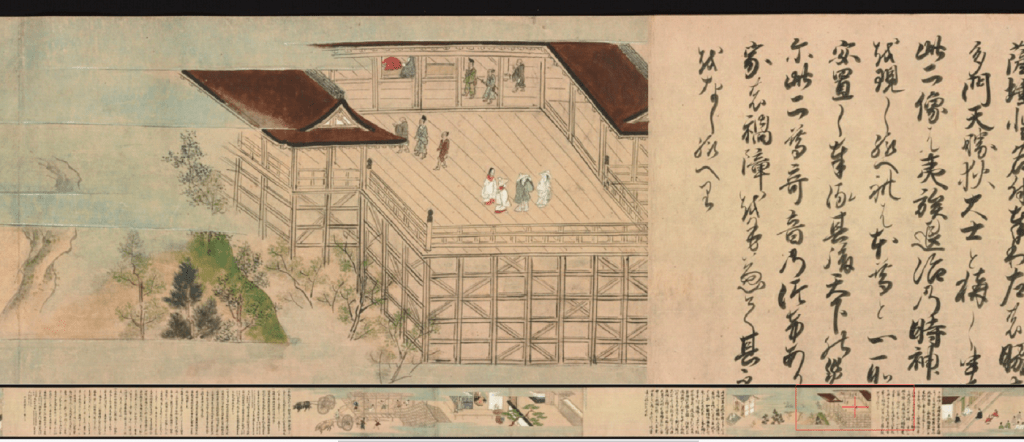
(Segment of Kiyomizudera Engi Emaki from Tokyo National Museum, 1517-20)
OCTOBER 2018.
NOTES
1 Mosher, Gouverneur. Kyoto: A Contemplative Guide. Tuttle, 1964
2 Ibid.
3 While writing this I learned that there is a waterfall experience at Kiyumizu-Dera (likely the namesake) known as Otowa Waterfall, that we completely missed and were not told of by our guides.
4 Was not able to find this character online while writing
 drdrr.work