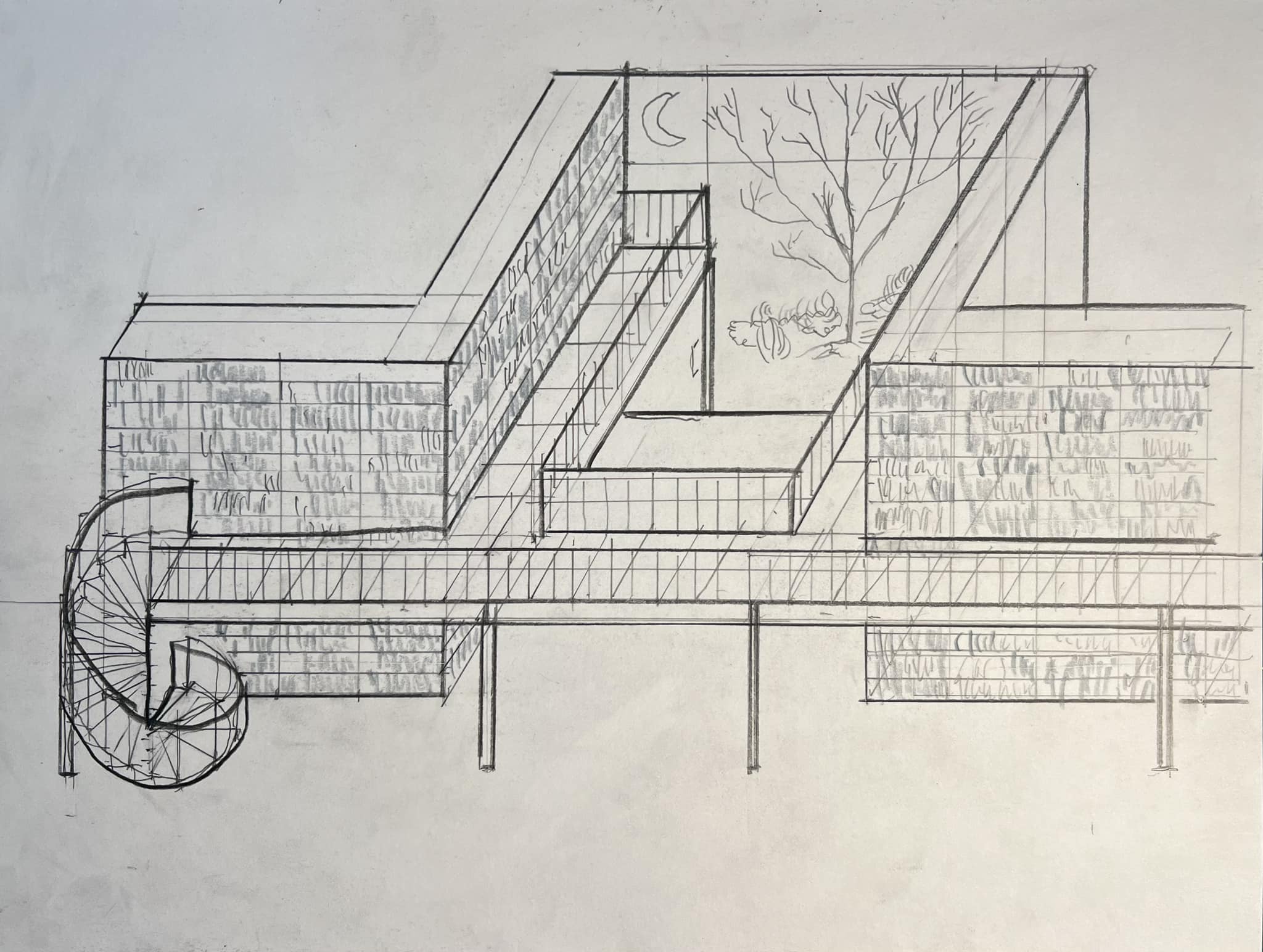
Revisited some rather tedious drawings of libraries I made in mid april of 2024. I needed some drafting practice and love libraries so I made a couple of images. One of the things that after looking a year later, that I realized I was doing, was trying to draw every book. A fallacy you see in landscape when the artist “paints every blade of grass”. Too much time spent and as we know ‘time is of the essence’.
The first to show is, “Arch(ive) of Triumph” and is a library in the shape of a Roman triumphal arch. I know, the title and premise are iffy. Books and shelf scaffolding everywhere, space left for elevators. Kind of fun though, in a 18th Century conceptualist (Ledoux or Boulee) kind of way.
Next are more 19th-Century seeming, I guess most likely cast-iron, multistory library drawings. Pretty standard and often these are fire hazards, but charming nonetheless.
One of the designs that stands out, to me, and I still like is this next one: the Library Residence. I love sleeping in rooms full of books, I sleep soundly in such conditions. In this instance, I was trying to imagine a house where all walls are bookshelves. Here is the living room and bed room.
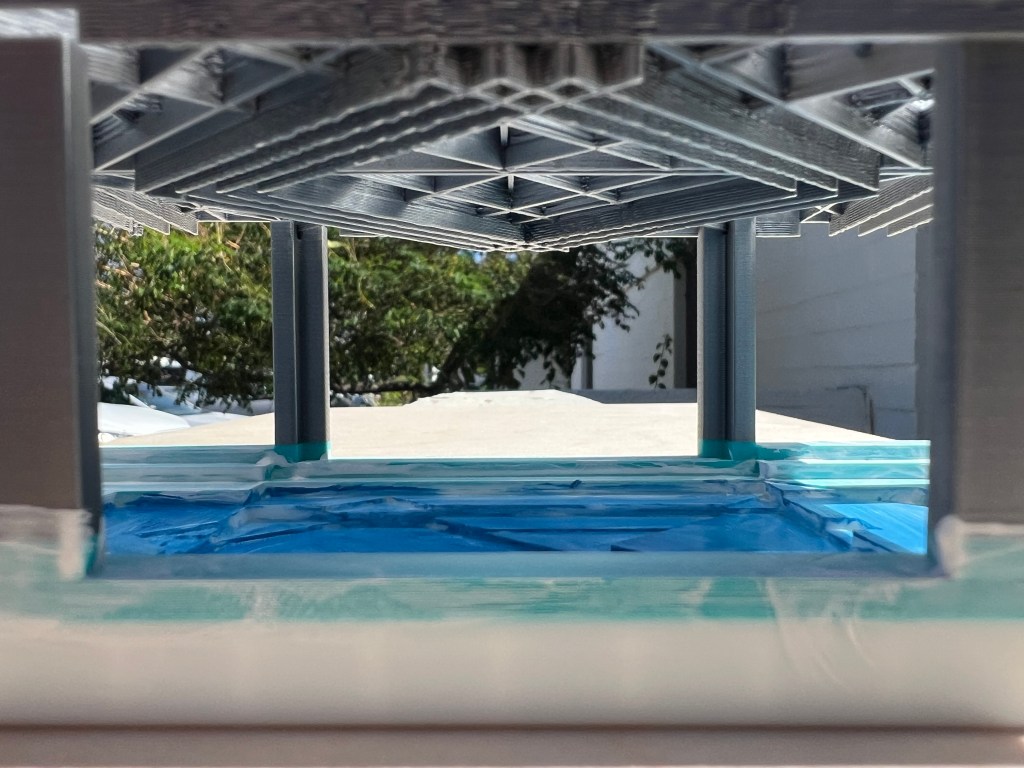
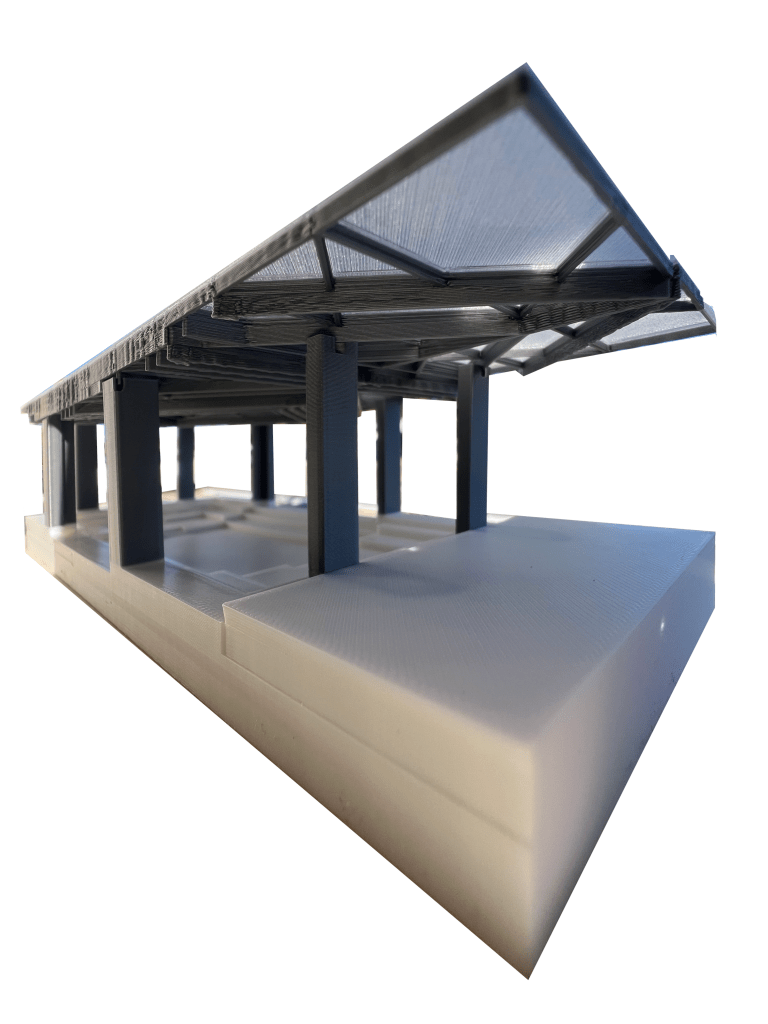
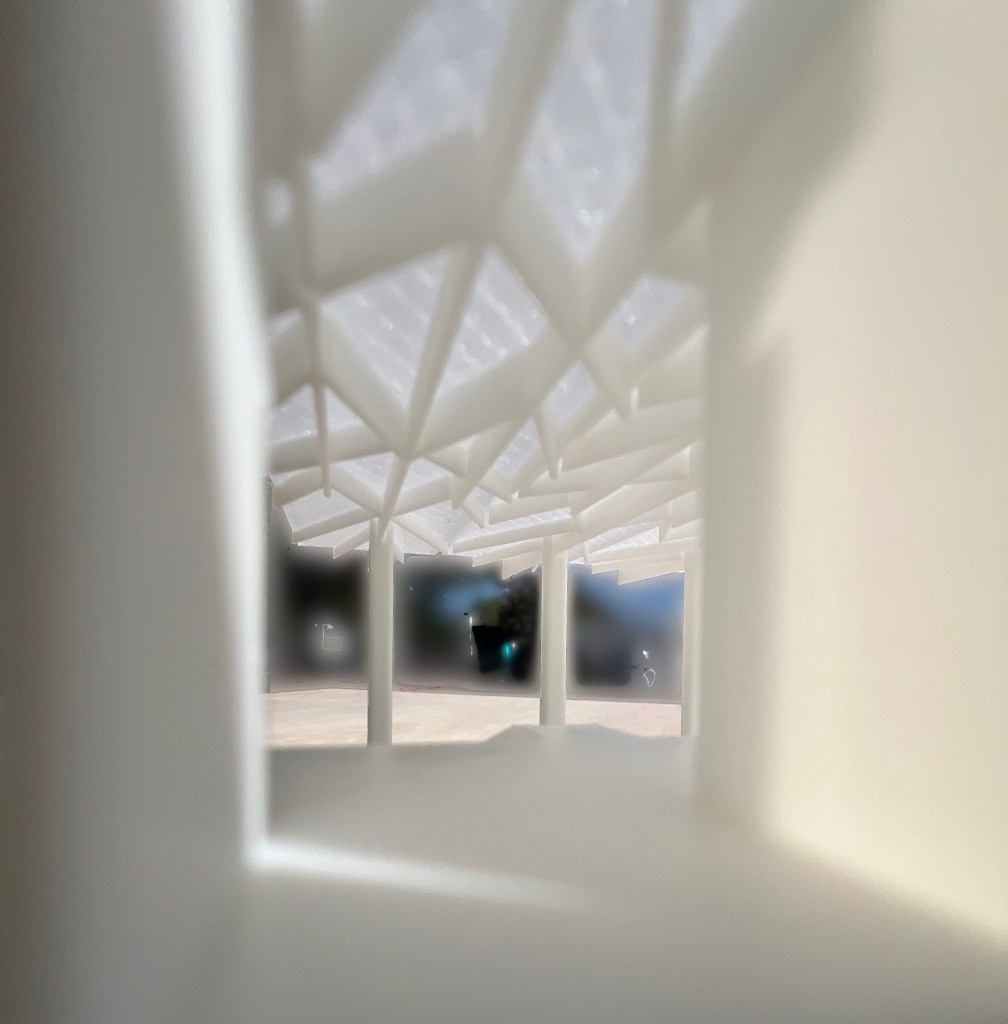
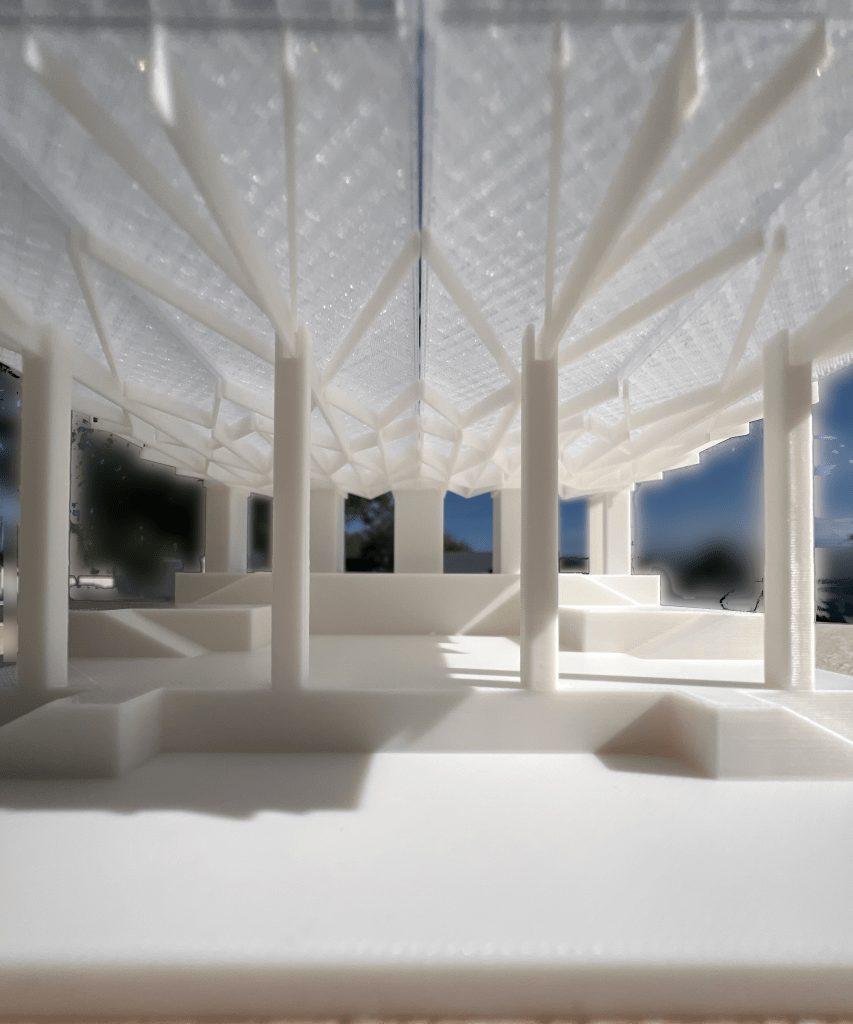
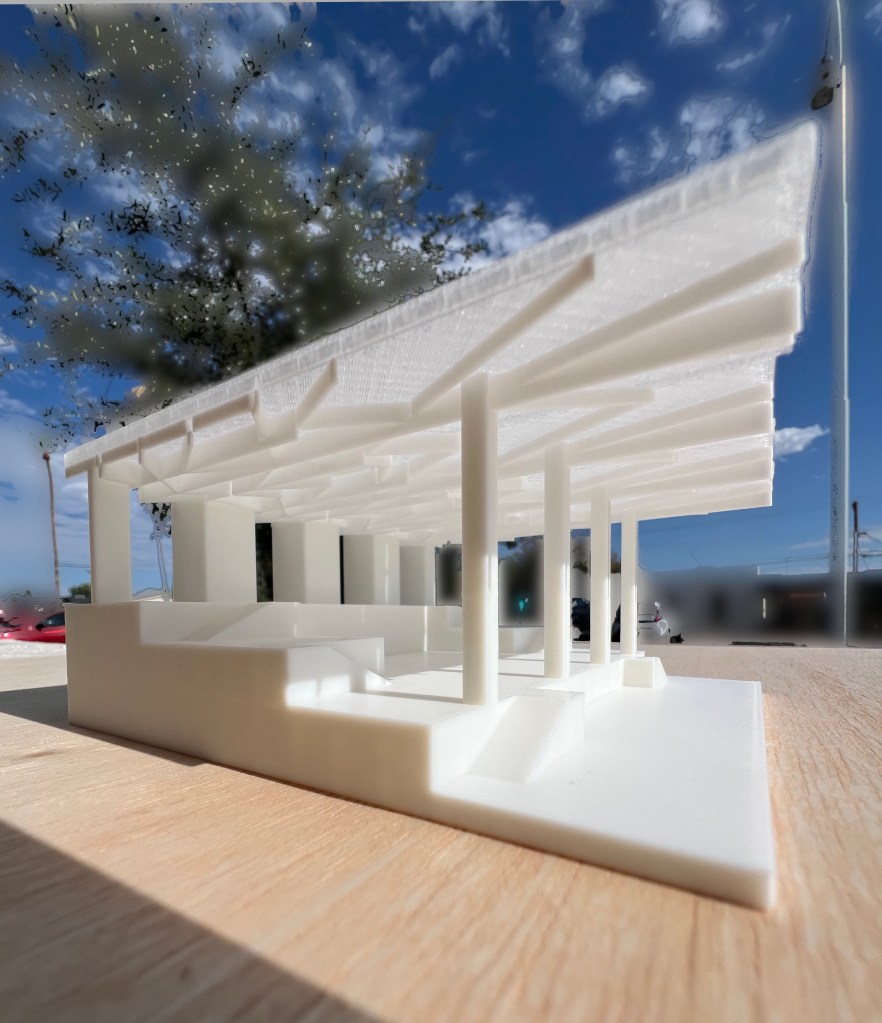
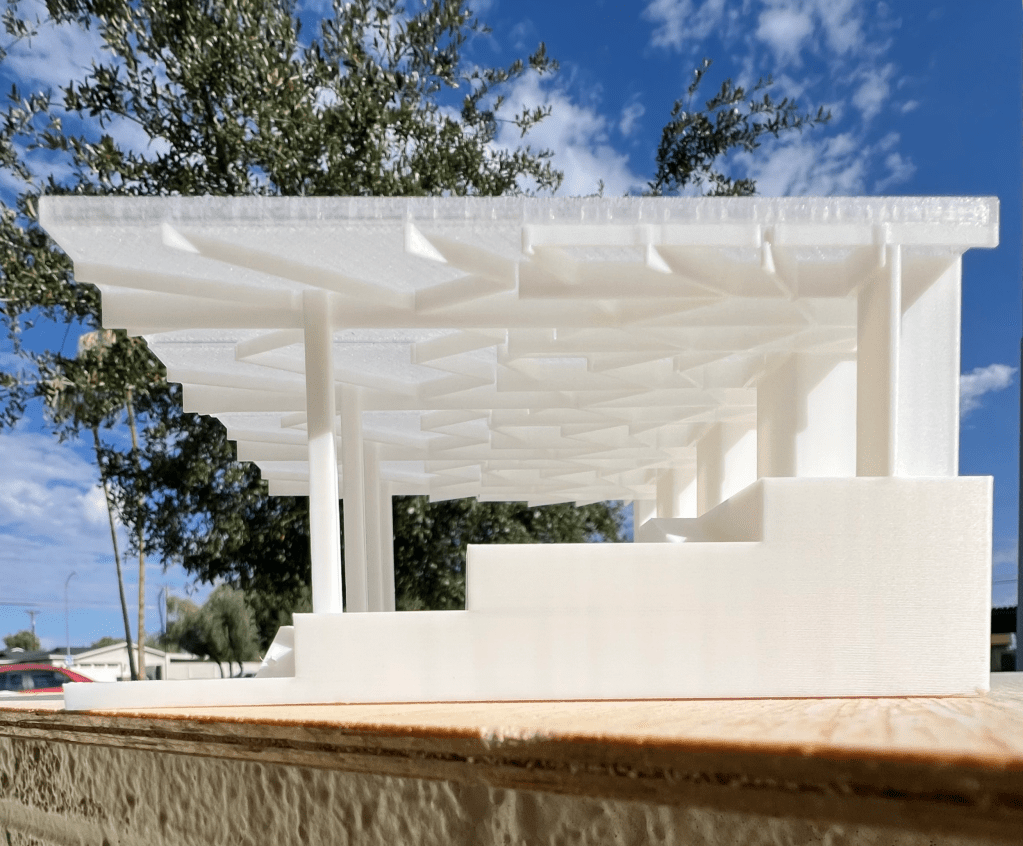
This is a model – prototype for 3D printing roofs and floorplate slabs, much like “Forest Beams Pavilion“. Here they are envisioned in a small pavilion that steps down into a pool.
Using printers in prefabrication is going to be a big deal. Trying to imagine what these can accomplish.
The idea is to print them on the ground then flip over and hoist into place.
You will see what I mean in the years to come. For now, enjoy the images.
Gagarin, Grigory. Alexander Column Scaffolds. 1830s (Wikimedia)
“There is a place for polishers of stones and for those who put stones together to make temples and palaces. But “experience” reminds us that a stone was once part of some stratum of the earth, and that a quarryman pried it loose and another workman blew the massive rock to smaller pieces, before it could be smooth-hewn and fitted into an ordered and regular structure.”
— John Dewey, Experience and Nature, pp.13-14.
This epigraph was clipped and saved with intent to go with another topic but after a phone call today, part of a tradition of twice, or so, a month catchup chats with a favorite former employer, it helped make sense of a recent puzzling interest. The friend and former employer had since heard a radio interview with the director of a film we watched together recently, and recommended that I listen to it. There was a certain rare vocabulary item, that he mentioned, but the audio on my car phone competes with the decibels of the full blast air conditioner this time of year. I will let you know when he replies about that.
VIEWING A FILM
A month ago, in 2025, late July, I noticed the title of a film in my peripheral, the word ‘Architecton’ caught my eye. I think it was in The Architect’s Newspaper. I instantly thought of a modernist, Kazimir Malevich who made works of the same name a century ago. Then turned to architectonics in a more timeless almost lithospheric sense. I knew it would not be a film about neither Malevich’s “Black Square” nor some kind of druidic Stonehenge or dolmen, exactly, but it got me anticipating something worth talking about. Before first watching the film, I took a quick glance at another review in The New York Times review. To avoid plot spoilers, I skimmed it only fast enough (maybe too fast) to see if it was something I would want to see, and asked the friend and former employer who also likes films like this, to see if he would join. I was drawn to this film, but I did not read the reviews enough to know what to expect. “It is a movie about stone” –that was about all I was prepared for.
If I were to have watched and either concurrently or immediately afterwards, put some words to what I saw, my account would be unique. That is often the case but it would be unusually unique, in this instance. Now I am reviewing it much later.
So in the first week of August, 2025, we went to the film at the only theater showing it for limited times and dates. From the start, I was not expecting to see destruction of so many buildings in Ukraine from Russian assaults to be highlighted . There was almost no story provided verbally, the friend I saw the film with whispered “Ukraine” but I had known and instantly recognized what I was seeing. I knew the destruction was in Ukraine but I was not certain in which cities. I have travelled in Eastern Europe and adore the people and places. In Architecton, there were no locations or dates given. This was a documentary but differed in that there were few verbal statements of “who, what, why, when, how” etc.
After the first sequences, some of the other locations were equally mysterious. The second sequence, (if I correctly recall) was a extremely uneasy landslide scene, I watched the Earth collapse and tumble, painstakingly slow for many minutes, I had no idea what was happening. I adore the Earth and Nature. What I was seeing was disturbing to see so many layers of the underground of Earth dismantled and upended. Much later I pieced it together with later images of mines, that it was a controlled landslide in mining. Some of the later sequences, were not instantly recognizable sweeping visual surveys (to a moderately travelled American) of places in the Mediterranean regions.
An enormous monolith at an archaeological site and a Roman ruin were shown, but they were not obvious locations to me. Some conversations with an architect and builders were philosophical. I studied architecture and adore it and these characters where interesting to watch and after so much non-verbal activity their conversations were a relief.
The two takeaways I can easily recall: 1) there is unjust destruction of Ukrainian lives, culture, and infrastructure in a wasteful ruinous war with no good reason, ongoing at present. 2) we might not see it this way, but we are altering of the Earth beyond recognition for all products and building materials, in this case, the overproduction of cement. Perhaps the second has a tenuous reasoning, “we need building materials” but I wonder if that is worth it.
Part of what I withdrew from the film and interview with the director’s message, is that a stone is much like us– a mountain is born, lives, and dies, and it is a whole, an ecosystem. In the film, mountains were levelled, mined, quarried, and materials were taken from these sources, extracted from nature, remade to build human civilization. They were irreparably altered, effectively destroyed in order to build civilization. And then they go wreck civilization, and bulldoze it into the hole left from mining the mountain in the first place. When they do this they destroy the Earth twice, twofold! not to mention the cultures, and peoples’ lives.
REVIEWING AFTER HEARING THE DIRECTOR’S INTERVIEW
As mentioned, the title initially evoked Malevich’s Architectons. These were constructivist basic rectilinear forms and multiplications of them. In the interviews, director would suggest, if making something of stone, make it “beautiful” so that no one would destroy it. No banal programs, no banal forms or rectangles. The selected architect in the film, even sees some of his portfolio as “horrible, rectangles in concrete”, the architect feels shameful of this bulk of their work that “is not beautiful”.
In the interview the directory discusses the Alexander Column at the center of St. Petersburg. If you know much Russian literature, this is mentioned in the poem by Pushkin “Ya Pamyatnik” a very ingenious verbal monument. Really a lot to unpack in that poem, (I included the text in Russian in a link with English commentary for language learners), might try that another time. On precedents in Russian poetry, there is also Osip Mandelshtam’s Kamen’ (or Stone in English). I did not include it in the sources, but highly recommend as it covers a lot of “beautiful” architecture that has been made of stone, because it is poetry and the film was so nonverbal. The Hermitage (also filmed in a slow and sweeping Russian Ark) and the Alexander Column, mentioned in the interview, are at the very center of St. Petersburg and are main attractions for the city, the construction of which seems a mystery to him. Another stone reference is in the very name of the city founder of this city St. Petersburg, as Peter means stone in Greek.
The director continues that urban idea for centuries is religion at the center, with streets focusing and leading to that center. He indicated a need for new centers, due to an ever more multicultural world. Architects asked knew no answer. Or had banal answers. Only one had a vision, “give it to nature”. I will admit I have thought in a design studio, ‘center the city on people and urban life, do not let cities sprawl.’ I love nature and I love cities. Will always think and rethink. So this vitally important message from the director after the hundreds of architects he spoke with, was the one that wanted “nature at the center”. This architect, selected by the director was our verbal guide in the film, very philosophical and worth listening to again.
Some last thoughts to consider, we can be distracted from seeing geology as a nature and as an organism. The stasis of stone may seem lifeless but it has a lot going on. From the interview, if we build in enduring materials, we have to find ways to build with “beauty”. As the director said in the interview, stories or readings of his films should not be the same across humanity, should we expect stories to be variable, but not beauty to be?
SOURCES
Dewey, John. Experience and Nature. Open Court Publishing Company, 1925.
This week we are approaching the next level of record heat in Phoenix. The area breaks another record for heat every year. I have lived in Phoenix for ten summers, that is the hard and sure measure of time here, the summer. What averages a three month season seems more like six months here. In fact, in my home city of Seattle, maybe two or three weeks of its hottest summer weather is comparable to months of clear skies in Phoenix’s winter. I have said to myself I will leave Phoenix for the whole summer every year and yet have never made it happen.
I have found that I need a temperature reset once or twice every Phoenix summer. The quickest trip is north to Flagstaff, a three hour drive and almost five thousand feet elevation gain, that is thirty degrees cooler on any given day. The town also benefits from is mountain breezes and shade from an extensive pine tree population.
Another little longer drive for respite from the severity of the summer is west to the Pacific. I have spent a year or so in Los Angeles two decades ago and nearly attended USC to finish architecture school. I had never travelled to San Diego until two years ago but have visited three times now in those last two years, as the climate is as pleasant as possible.
This summer for my temperature vacation I decided to travel to San Diego and Los Angeles areas. I asked around and found some event suggestions. One concert and one drawing workshop. I planned my trip around these. I ended up missing both but they helped structure my trip. The workshop especially would have been good, it was a plein air drawing session, so I decided to practice at least every day. I packed colored pencils, sketchbooks and watercolor tins. I was not looking forward to drawing clear skies with pencil so I brought watercolors and brushes. Even though I ended up happy with the colored pencils.
I booked my first night just outside of San Diego in La Jolla. As I read it was 70F while Phoenix was 110F. I checked the other areas of interest, Pasadena was in the middle or high 80s, which makes sense because it does not as directly benefit from the ocean’s thermal mass and breezes thirty miles inland. I planned one night in Pasadena to see the Huntington Library and its garden grounds.
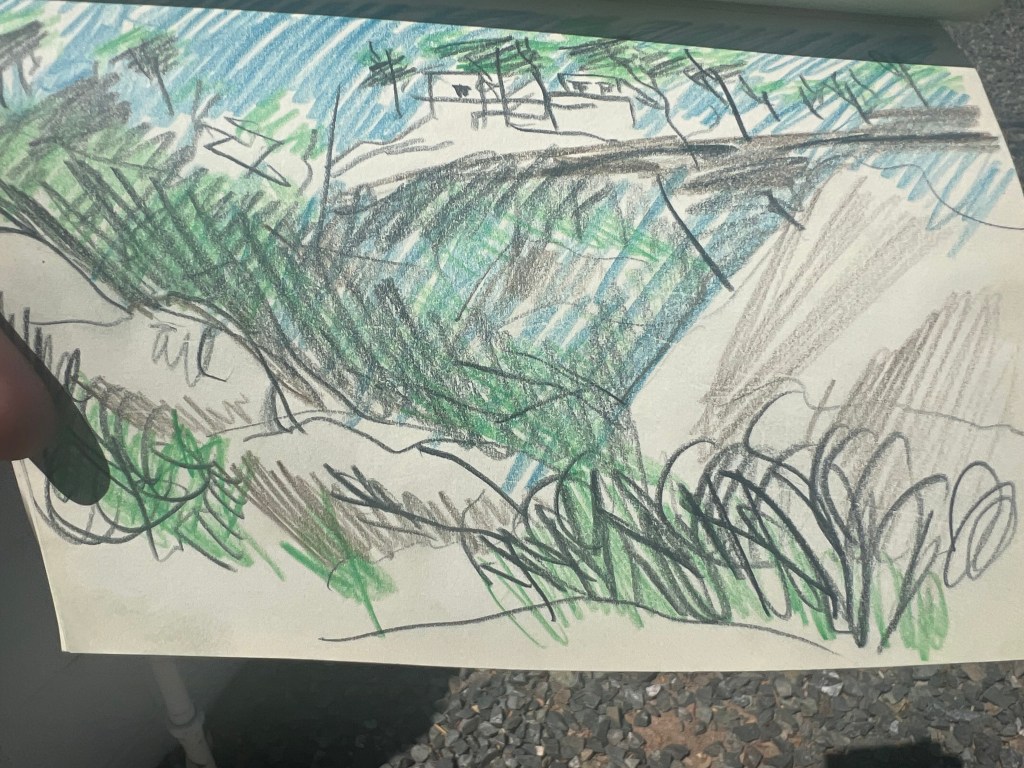
In La Jolla I asked my host about nearby scenic ocean hikes, she suggested Torrey Pines State Park. I had heard the name Torrey Pines from golfers, that they have a major golf tournament, and I said “isn’t that a golf course?” She told me that there were miles and miles of trails at the State Park. I visited it and was completely impressed by the ecosystem and presence of nature. I went to the top of one of the bluffs and found a ranger station adobe lodge that the docent told me was originally a restaurant. Taxidermic specimens of the local fauna lined the walls of the gift shop. I asked the docent for a reasonable hike recommendation, and he sent me on my way. I found a bench and drew a ravine between two bluffs. Not my best work but my first plein air drawing in a while.
In the morning I went to the Pacific at La Jolla to watch the sun rise. The sun rises opposite the ocean and i listened to the din of seagulls and sealions. I took it all in. Sketched the sea and felt better about the second drawing.
After visiting San Diego I drove north and had a lot of time before my check in time in Pasadena. I ended up driving to the Getty Villa in Malibu. Traces of recent wildfires were disheartening. The Villa was nice. I took an art and architecture tour, but missed the museum collections due to whimsical planning and timing. I was more inspired by the newer facilities from the 2000s much more than the 1970s classical remake. The gardens were nicest and our guide related the flora selections to antiquity’s myths and poetics, but I appreciated secondarily the concrete textures of the 2000s facility and its raw quarry inspired designs. The finesse of the accessible routes and circulation that the architects planned were another high point. I heard the architects wanted to monumentalize these ramps and paths that are usually temporary or afterthoughts to meet codes. Unfortunately I did not sketch anything at Getty Villas.
Took me an hour and a half along the interstate 10 to get from Malibu to Pasadena. It is only 18 miles! That might be why they call it the 10, because the speed in that stretch is around 10 miles an hour. Due to the delay I stayed around my lodgings and skipped the concert since I did not want to be trapped in traffic again. Near where I stayed in Pasadena I visited the original Trader Joe’s and the house where Einstein lived while at Caltech.
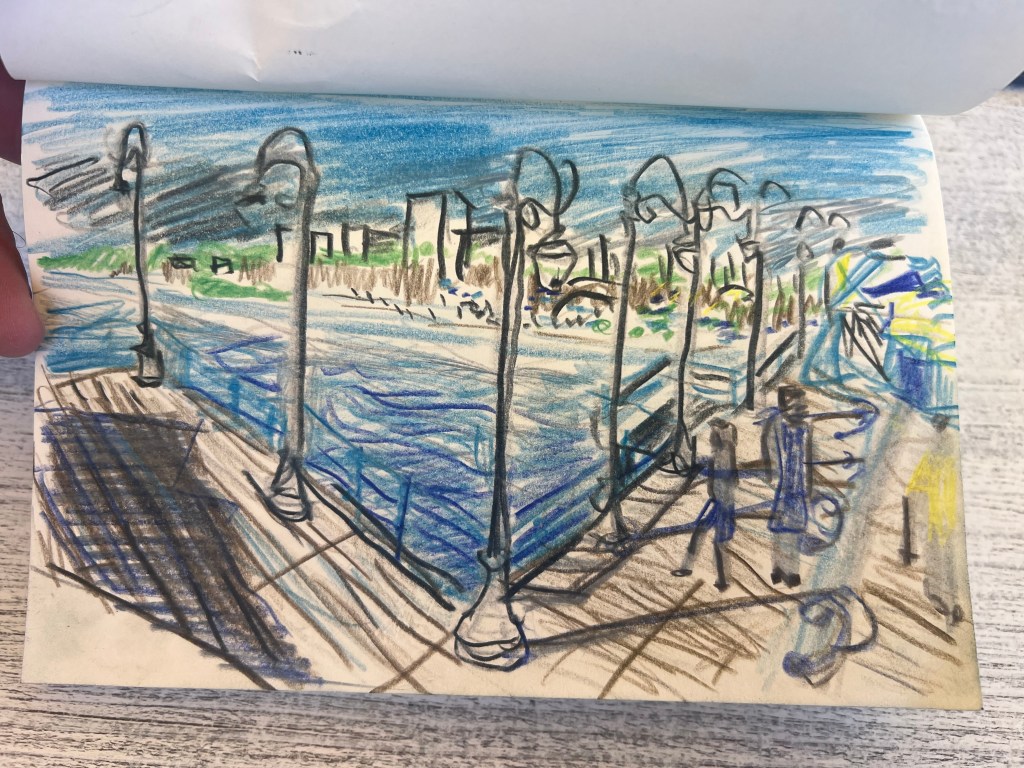
I did not visit the Huntington library the next day, as I planned, but instead I headed over to Santa Monica early to walk along the beach. I also went out on the pier for another sketch looking back to the shore.
I stayed in Santa Monica on the third night after watching the sunset. The room was oddly warm and humid and I woke up extremely early. Checked my car on the way out and saw a coyote wandering the streets at 4am. Nature is present!
The workshop was in a few hours but I decided to see another town I had never before and drove up the PCH to Ventura. I made it to the beach at dawn and walked up the wharf and enjoyed watching surfers and waves. At a reasonable waking hour I wrote a friend from Ventura. He replied, “why there, why not Santa Barbara?” So I visited SB too but planned to stay in Ventura. I ended up resigning to skip the workshop, feeling accomplished e ouch after daily sketches, Both Ventura and Santa Barbara were foggy, charming towns and a little chilly. They both had street fairs starting at 10am. Annual Fiesta. Ate a freshly caught snapper on the pier in Santa Barbara, among the best meals I can remember. Santa Barbara displays many signs, with a reminder of their municipal code prohibiting smoking and making a smoke free city.
Around noon, I returned to Ventura and all the hotels were booked for the weekend. But I wanted to traverse Los Angeles on the way back to Phoenix, at the earliest possible hour so needed to find a place to stay. Eventually I found one that was overpriced and under maintained. Went to the beach again, to be sure to draw.
I left early the next morning, feeling my body temperature successfully reset and recharged to face the next Phoenix heat record.
Here is my essay closing resolution: next trip to Southern California will be by plane and involve no private car, only public transport. I do not want to contribute any further to the congestion and smog of this lovely city and region.
I have taken some care and time to read Latin lately, for the sake of learning. I have focused on classical and renaissance texts about architecture and related fields. It all began with the term “barrel vault” we use to describe a well worn feature of Roman design. I went to look for the term in the original and found some interesting results, will write about that more later in a large work I call “A Natural History of Architecture”. So far in exploring antiquity, I have noticed enough content to supply my curiosity to my heart’s content.
Today what puzzles me most is an oddly anachronic find in Alberti. I went looking for the oldest edition I could find a scan of and it is the 1541 Strasbourg. The area of interest is Book Four, which has a large “universal” or geographic as well as ethnographic scope.
Liber Quartus, cui de universorum opere est titulus
Alberti cites many of his ancient sources, and adds descriptions of Gauls, Britons, Druids. Egyptians, Ethiopians, Arabs, various civilizations. What stuck out, to me, was this:
Apd Americos (inqt Liuius) regio fertilissima est, fed, q plaerumq ubere solet agro euenire, homines alit imbelles.
I encourage the reader to translate, as my Latin is lacking, but my interpretation, even if it is 1500 years off,”(according to Livy), the American region is fertile land and when this is the case it nourishes non-belligerent peoples”.
Livy lived around the turn from BCE to CE. Around year zero. 1500 years into the Common Era, Alberti wrote De Re Aedifacatoria in the 1450s. Alberti died in 1472. Amerigo Vespucci traveled to the Americas decades after that. Christopher Columbus traveled to the Americas decades after Alberti died as well. After Columbus died in 1506, the term Americas was first used to described the lands. When I first noticed this, my mind sped and I tried to reconcile what I was reading. After trying, I rested and looked more the next day. I soon found this in the Paris edition of 1553
Tite Live dict que la region d’Amerique est merueilleusement fertile, mais qu’elle nourit des hommes trop docillez & debiles, ainsi que font communemet tous pays gras abondans en richesses.
I encourage the reader to read and translate, but the meaning is pretty much the same as in the Strasbourg text.
In order to understand, here are some options. There are a few scenarios: I) I am still learning Latin and am oblivious to what is in these texts, II) Alberti, and or even Livy wrote about (Americos) Americas before they are known by Europeans, III) an editor sometime in the 1500s introduced the line about the Americas.
I checked a classical Greek and Latin concordance and did not find any mention of “Americos” therein. Will not go searching for the term in Livy, at present. Going to presume it was a false and fanciful idea of the editor who introduced it. After finding the Paris translation with the America line translated into French, which I am more experienced in, I am confident we can rule out scenario I).
Conclusions: If time is of the essence, then Renaissance anachronisms are more distractions.
Ever since I completed my dissertation and knew managing a book scale document was feasible for me, I like keeping a prospective book topic. For a while I was working on one called Architecture of a New State. About architecture in Arizona around the time (just before and after) it became a US state. I got pretty far along in that one, but put it on hold for several reasons. Now I am working on Architecture of the Sun, and see it might be of much more than local significance, perhaps universal significance. Overwhelming but important. There is some Arizona in there for sure but the for now it is much more encompassing. Here is my outline from June 21, 2025:
Architecture of the Sun
Science of the Sun Solar systems Solar time keeping Sunlight and optics Heat and energy: accepting and avoiding rays
Landscapes of the Sun Desertification The Sun and water
Architectural Derivations from the Sun Radial solar cities Sun temples Housing Sun gods, Sun kings Sun religion, Sun governance
Modernity and the Sun Solar equipment: astrolabe, sundial, sextant, armillary sphere. Solar orientation: sun paths and charts Solar materials: sun dried earth, daylight catching, solar energy catching
A few years ago I found a half dozen or more high quality astronomy books at a second hand bookstore in Mesa, Arizona. Felt like an unlikely find, but these were all from top academic publishers, and I read them. They were all published over fifteen years ago and all warned severely about looking at the sun, ESPECIALLY NEVER TO LOOK AT THE SUN THROUGH A TELESCOPE.
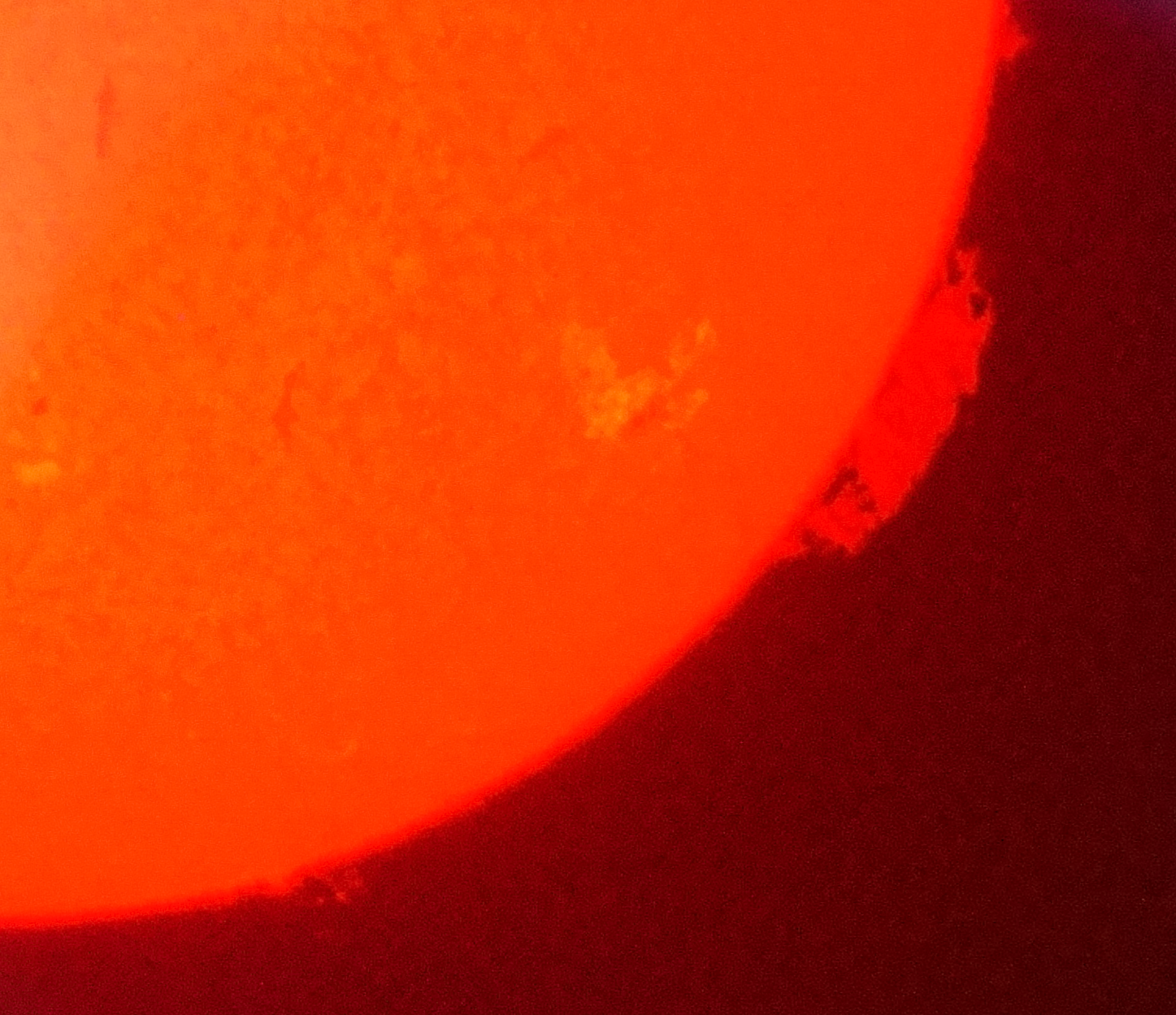
Years and filters and scientific advancements later, I did just that. I visited the Lowell Observatory in Flagstaff on 7 10 2025 and took several looks through a solar telescope. Apparently advancements have made it possible through specially filtered instruments, and I was eager to see.
The perimeter is the area I found most interesting. There are enormous flares or “prominences” that I tried to capture with my camera applied to the view finder. See below.
As a current resident of the Sonoran Desert, the sun is ever-present and inescapable. If I stay here I need to adapt myself, my lifestyle, my environment. We all do. I would rather not live in an Anthropocene, but more naturally in more of a Heliopocene.
“Standards of Excellence: Members should continually seek to raise the standards of aesthetic excellence, architectural education, research, training, and practice.”
–AIA Code of Ethics, 2022
In the first few statements of the AIA Code of Ethics is the above (Canon I, Ethical Standard 1.2) that mentions furthering research in architectural practice. In addition to Ethical Standard 1.2, the Institute promotes research through chapters of Architectural Graphic Standards and the Handbook for Professional Practice, as well in AIAU continuing education credits. Research may seem to be something we all already do, as it is a standard nearly everyone in practice knows of; and as such we all must work to keep improving on what is set as a standard.
Architecture offices have varying degrees of research included by the AIA requirement that architects have university training. That research is obligatory. Another bridge with academic research is that offices may have university clients, and dedicating researchers or research teams in the office helps build common language with clients working in research. There are also many architects that teach or have positions as research faculty at universities as well. Continuing education, offered at many opportunities, adds to the equation.
Heightening research can give an office several advantages,
Excellence: research can inform best practices and improve performance. Funding: research grants and awards can expand options for office income. Credibility: research includes scientific theories and methods that add to project authority. Common language: Clients working in research or academia can relate and better understand the work. Applicability: research benefits not only immediate stakeholders, but also can be published and conveyed to the profession, and public.
A framework for research in architectural practice, as modelled on standard dissertation format, is as follows: I) Introduction: after briefing, help define and clarify scope and goals of project. II) Literature: review literature and precedents applicable to project goals. III) Methodology: describe and outline research design and method. IV) Results: after research is conducted, convey results. V) Conclusions: summarize research, discuss implications, and make recommendations.
Architectural research takes many forms, can be performed with many methods, yet its medium is knowledge and information. Dedicating researchers or research teams in offices can help better serve the offices, clients, profession, the environment, and the public.
















 drdrr.work