First an Introduction, a Personal History of Printing
I started learning 3D model making in design studios in the 1990s. Digital design was gaining traction then. In architecture school in Seattle, one of my professors, Professor Johnson was a president of ACADIA. My colleagues and I learned CAD of all kinds but we were also learning the earlier design methods.
Quickly and for clarity, I should mention two terms, CAD and CNC. Computer aided design (CAD) is any kind of design eased by computation. It is a very general term and is not brand specific. Computer numerically controlled (CNC) devices are manifold, but for the purposes here either add or remove materials, they can be subtractive such as routers, lasers or can be additive like the 3D printers on the market today.
I first saw and used, (or even heard of) a laser cutter in internship at Eisenman architects in New York, around 2003. Universal laser cutters were the most advanced technology for design I had gotten access to, at the time. What we would do was cut out our CAD profiles or sections in a planar sheet material with the laser then assemble them by hand into a 3D object. We were making a competition entry and the team sent me to the SOM office on Wall Street and Stern’s office nearby to use their laser cutters. We got second place in the competition and I did not get hired so went home with lots of excitement and ideas, after that.

Back in Seattle after the internship, Professor Johnson helped me access more lasers at the University. I bought a license to Rhino 3D model making software in the early 2000s and would go to their renovated post office headquarters in the U District and talk ideas for new tools in the software. They asked me to learn C+ programming language and I did a little bit. Professor Johnson recommended I attend the 3D Printer World Expo in Bellevue. I was on my way back to architecture school in Arizona and knew this would be worth trying. Entry to the 2014 Expo was only $25. Pretty good for a conference, I still have the tote and some brochures. 2014 was a significant year overall for printing, for the maker movement and for me personally. That was the year that President Obama hosted a Maker Fair at the White House. I did not attend, but I wish I did. This event really highlighting how important these devices are now, will become, and it exhibited the spirit of a movement.
Once in Arizona, at architecture school I began using printers for my studio projects quite regularly. We had student memberships at a lab called Techshop. My first 3D printer trainings were in Formlabs resin printers and Makerbot PLA printers. Allergies to resins made that choice easy, and I printed quite a few with the Makerbots. We also had access to digital fabrication labs at ASU Design School, a few university engineering labs, Hayden library labs, and also the Polytech Campus labs. I made use of these often, and experienced quite a few different 3D printers.
At some point in graduate school, a friend working back in Seattle, at Amazon, bought a Monoprice Maker Select and getting really good results, price was good and not resistible. I bought my own, and used it nearly continuously. With the Monoprice I made most of my portfolio of over 100 prints. I also did a lot of repair and maintenance on the printer. When all else failed, Monoprice had me send the broken printer to Rancho Cucamonga for fixes. The policy of refurbishing was very good.
Still while in graduate school I published a short article in the journal Discipline, called “Printing a Garden”. Many of my projects were about helping nature with design, printing pots and planters and models for green walls to allow for organic growth.
At a point I was hired by the university for an internship. The work was building a foam model using GIS data into a subtractive CNC routed, large scale model of the Rio Salado across greater Phoenix. This took many months to gather data, materials, and to mill the pieces.
I began to explore different materials for printing. Wood can be used with a CNC router, and there is also wooden filaments that produce 3D prints similar to MDF boards. I also found out about a service called Shapeways that has options in most all materials– wax, ceramic, gold, silver, steel, etc. I sent them files for jewelry I designed and was pleased with the stainless steel ring they printed and shipped easily and affordably.
After graduate school, one of my professors hired me to repair his office’s large print Modix printer. This happened twice in two years.
In 2024, I used the Mesa Public Library lab to print some classically inspired tomb designs. These were printed then molds were made in plaster and then recast. The quality and speed was noticeably improving from my efforts before 2020.
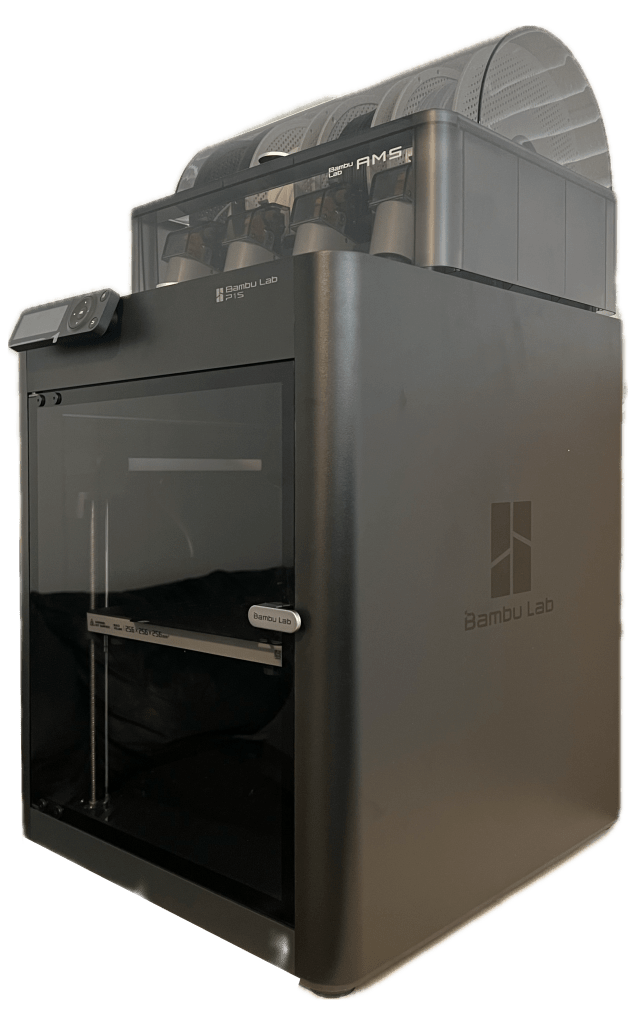
My Initial Review of the Bambu Labs P1S 3D Printer
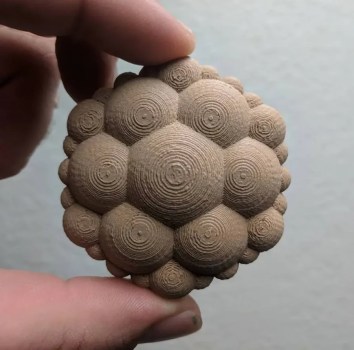
My first impressions of the Bambu Labs printer highlights and features, were mainly surprise at how far this technology had improved. I bought the printer in late June 2025. In the first few prints it excelled in the key three terms: speed, accuracy, price. All top notch. It is about five times faster than my last printer. The quality is remarkable, out of the box it has no uplift, the layer lines are almost unnoticeable even. That was a surprise. The price is a little expensive but in this case I am getting excellent results.
I decided on the Bambu Labs after searching around and reading a Wirecutter recommendation. I did not chose the model they reviewed but the P1S with AMS. Very happy with it so far. The app that comes with the printer has so many additional features. The app monitor is really nice, includes essential data and a shutoff option, I just wish the camera was mounted lower to check if the nozzle is depositing correctly. But if that’s not going to be an issue then I’m happy. One app feature that is so convenient but not aligned with my intent for printing is that there is this idea that people can just search and print whatever they want automatically and predesigned. I am not interested in that really. I feel like I’m not going to just select stuff and print it, for the most part, I’m only interested in prints of my own design and ingenuity. The reason I print, is to test ideas and invention.
The AMS is going to be great I like that it is sealed to keep the filaments fresh but I’m hesitant about multi material prints until they can do gradients. I have some ideas about how to use polychrome just concerned about time and materials, at this point in their development.

The first couple prints on the Bambu had nearly perfect quality. So far, I have used it for about 8 prints in 10 days. Will revisit in a few months, after some wear. But so far, there are no flaws in the base layers, at all. No issues with the height or Z axis. Even thin and tall pieces that every other printer I have used before would have knocked over this one finessed and printed perfectly. First multimaterial print was a success. So far, highly recommended printer.
Postscript, A Vow
My own reasons for printing, are because this medium offers an inspiring architectural testing ground. The only thing of interest to me in 3D printing is visualization and prototyping of innovations in design and architecture. Architecture is so expensive. Full scale buildings are not well suited for experiment, there is too much at stake: time, cost, energy, materials, even potentially people’s comfort or health. Why build something for a million dollars when you can print a small scale experimental version to think it through for so much less? I believe 3d printing will be used widely at full scale someday soon. We already have our first 3d printed buildings. In Tempe, Arizona, Habitat For Humanity printed one in 2021. Eventually printing buildings and components at full scale will be here, that is for another day. I even vowed recently, that the first home I own will be my own design 3D printed. I do not usually make vows or pledges, since no one knows what the future will hold, maybe I should make them more often, but I like this one. Let’s see if I can make it happen.
 drdrr.work